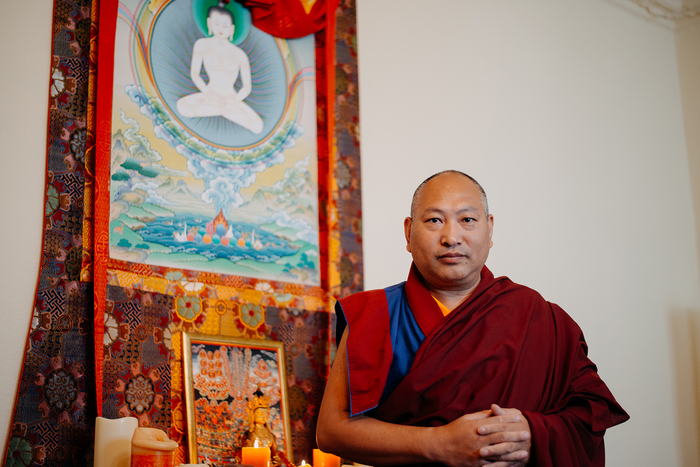
Berlin isn't the first place you'd expect to encounter the leader of Tibet's oldest spiritual tradition, but here in the city of Study Buddhism’s headquarters, I'm sitting down with His Holiness Lungtok Dawa Dhargyal Rinpoche, the 34th Menri Trizin—the "Holder of the Menri Throne." It's a rare opportunity. His Holiness has traveled from Dolanji, a small town in the foothills of the Indian Himalayas where Menri Monastery stands as the principal seat of Yungdrung Bön, a lineage that predates Buddhism's arrival in Tibet by millennia.
The title "Menri Trizin" represents the highest spiritual authority in the Bön tradition, a lifelong appointment that His Holiness has held since 2018. His path here wasn't one of ambition but of devotion and, as he describes it, destiny. After nearly 25 years of study at Gamal Monastery in his native Amdo and another 15 years at Menri in India—where he earned a second geshe degree and served in administrative roles under his predecessor—his name emerged from an ancient divination process involving prayers, rituals, and auspicious signs.
In our conversation, His Holiness speaks candidly about the historical tensions between Bön and Buddhism, the distinctive structure of Bön monastic education, and his vision for interfaith harmony built on genuine textual study rather than superficial ecumenism. Then, we finish up with a perfect morning routine. Read on to find out what it is. Enjoy!
Study Buddhism: From a Chinese school in Amdo to the highest throne in the Bön tradition—that's quite a journey. How did a childhood in Tibet lead you to become the 34th Menri Trizin, and what was it like when your name emerged from the divination process?
His Holiness the 34th Menri Trizin: Until the age of five, my childhood was like that of any other child. I attended a Chinese school and at eight I joined the monastic community at Gamal Monastery in Amdo, where I studied for nearly 25 years—learning rituals, chanting, logic, and philosophy, and earning my first geshe degree.
In 1997, seeking further training, I came to India to meet His Eminence the 33rd Menri Trizin and joined Menri Monastery. There I completed my second geshe degree in 2012, studying sutra, tantra, and various mind teachings. After I obtained my degree, my root teacher, the 33rd Menri Trizin, advised me to remain at the monastery, where I served in several roles within the Yungdrung Bön Monastic Center Society, including secretary and treasurer.
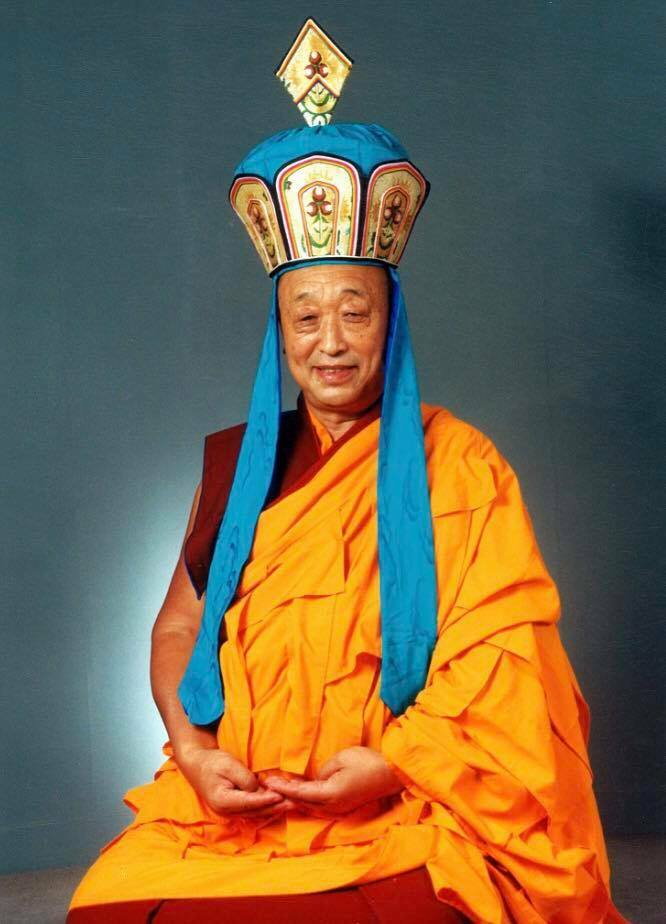
In 2017, His Holiness the 33rd Menri Trizin passed away, and a successor needed to be found. With advice from His Eminence Yongzin Rinpoche, His Eminence Menri Lopon Trinley Nyima Rinpoche led the process. It was decided that the new Menri Trizin should be appointed outside of Tibet so that he could stand alongside the other Tibetan religious leaders. Letters were sent to more than 100 geshes, and after many withdrew, about 60 took part in a sign examination looking for auspicious signs. In the end, my name came out.
Although I personally felt that I did not have sufficient qualification or confidence, according to the Bön tradition, whoever's name appears in the sign examination has been appointed by the gods and protector deities. I accepted this as my destiny and became the religious head of all Bön followers. With the support of many great teachers and individuals serving Yungdrung Bön, I have continued my responsibilities as Menri Trizin with courage.
Many people assume Buddhism is Tibet's original spiritual tradition, but Bön was there first. Can you help us understand where Bön comes from and how its history relates to Buddhism's arrival in Tibet?
The first teaching called "Bön" is the Dharma founded by Tonpa Shenrab. In our tradition, it is said that Bön has a history of around 18,000 years and that the Bönpo tradition has spread from that ancient time, coming down in a lineage from a place called Tazig and Zhangzhung.
When we talk about Bön nowadays, we speak of Yungdrung Bön. If we look at Bön in general, it has become something extremely broad—referring to both the earlier Dharma teachings and the present Bön tradition combined into one. What we often call "Bön" today, therefore, is this broader understanding.
According to my understanding, the Dharma of the Bhagavan Buddha Shakyamuni had not yet spread to Tibet before that. In the 7th century, during the reign of the Tibetan King Songtsen Gampo, the Dharma teachings of Buddhist monks began to spread to Tibet.
Now, I'm not an academic researcher; I'm a spiritual practitioner. And being so, I must have confidence in our own distinct textual tradition. But no matter which version of history you look at, if you ask what existed in Tibet before Songtsen Gampo, I believe that the teachings of the Buddhist monks had not yet arrived. In that case, Bön was present in Tibet previously, and this is what is recorded in our texts.
The Dharma of the Bhagavan Teacher Buddha Shakyamuni has existed for about 2,500 years. We can therefore say that the age of these two is not at all the same, and the length of time they have been propagated in Tibet is also not the same.
When people look at Tibetan Buddhism and Bön today, they often see more similarities than differences. What are the essential distinctions that matter to practitioners, and do both paths lead to the same destination?
In my opinion, there are two types of Buddhism in Tibet: the Buddhism founded by Tonpa Shenrab, and the Buddhism taught by Buddha Shakyamuni.
Sentient beings have different mentalities, and so some are inclined to Bön practice, while others are inclined to follow the Buddhist teachings of Buddha Shakyamuni. Both are good!
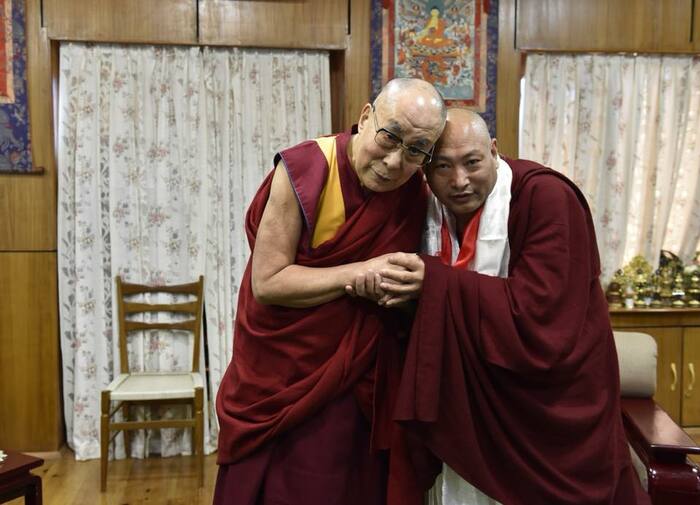
The most important thing is to have the state of mind that wishes to eliminate one's sufferings of samsara, and, ultimately, to attain liberation and the precious enlightened state of omniscience. I think that with such a motivation, whether you study the Buddhist Dharma or you study the Bön Dharma, the ultimate state you reach—the state of Buddhahood—has no difference at all.
What does a complete monastic education look like in the Bön tradition? Could you walk us through what a student encounters year by year at a place like Menri Monastery?
In Menri Monastery, the first year is dedicated to studying the collected topics. The second year focuses on pramana, or valid cognition. The third year covers the tenet systems of Prasangika and Svatantrika. The fourth year is devoted to the ten bhumi (stages of the mind) and the five pathway minds. The fifth year focuses on prajnaparamita, the perfection of wisdom, followed by the study of madhyamaka, abhidharma, and vinaya. All these subjects belong to the sutra tradition.
Then, for tantra, there are the outer tantras and the inner ones, and after that comes dzogchen. Furthermore, the outer tantras have two classes, and the inner tantras have two classes as well. Classified like that, they correspond to what other traditions call "the four tantra classes," matching one to one. It is said that we need to study all of these.
There are also the southern treasure text teachings, which contain the nine-staged vehicles of the mind. They are classified as four causal vehicles and five resultant vehicles, presenting a different way of organizing the tantra classes.
In addition, there are the secular fields of knowledge. These include Tibetan spelling, Tibetan grammar, and poetry; both black Chinese-style and white Indian-style astrological calculations; Sanskrit grammar; ritual music; crafts; and medicine. All of these together are known as the "five major secular fields of knowledge."
You've earned Geshe degrees from both Gamal and Menri monasteries. How does the Bön path to becoming a Geshe differ from what happens in traditions like the Gelug, particularly regarding tantra and dzogchen?
For the Geshe degree at Gamal Monastery, I studied slightly fewer subjects than at Menri Monastery, although in general the studies are almost the same. Since Gamal Monastery is one of the upholders of the Menri tradition, it has to align its curriculum with the customs of Menri Monastery. However, while I was at Gamal Monastery, I was unable to study tantra and dzogchen, and I gained the Geshe degree there only on the basis of sutra.
At Menri Monastery, when they speak of the sutra, tantra, and mind-class teachings, I studied the complete teachings of tantra and dzogchen. To obtain the Bönpo Geshe degree, one has to study in full the complete sutra, tantra, and mind-class teachings, as well as the secular fields of knowledge.
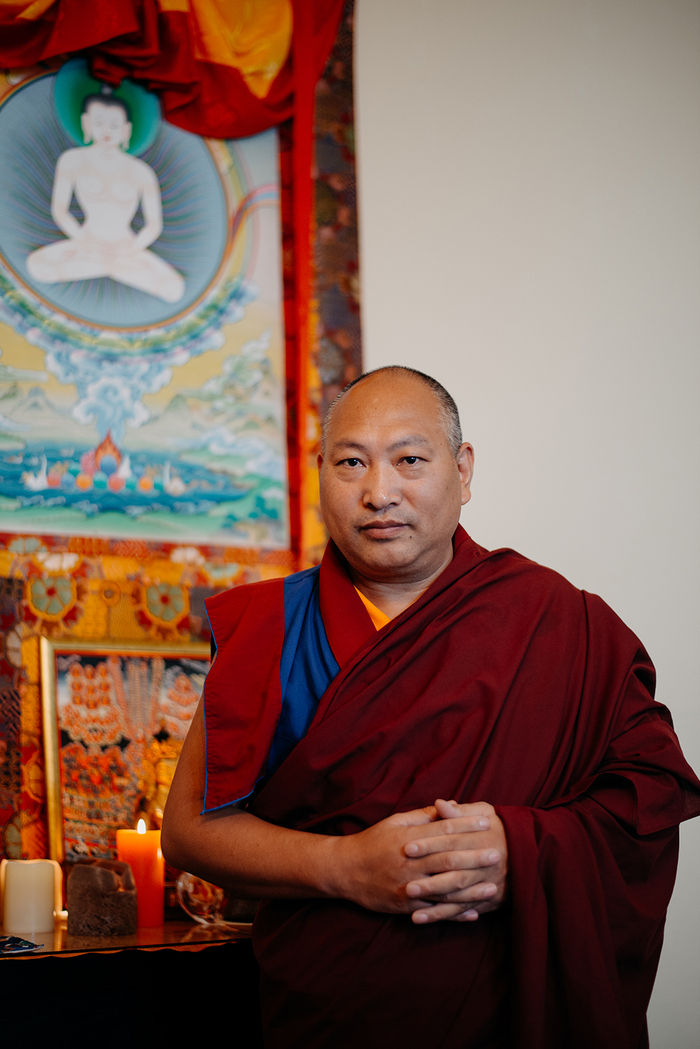
I don't have clear knowledge of how it is in the Gelug tradition; however, in that tradition, it is only after they have obtained the Geshe degree that they can pursue what is called the Ngagrampa degree in tantra. There are no mind-class teachings; they don't have the dzogchen teachings. I can say decisively that they do not have them.
Apart from that, the main difference is that, for those of us following the Bön tradition, we cannot obtain the Geshe degree unless we have studied sutra, tantra, and the mind-class teachings. In the Gelug tradition, the highest study in the Sutra Paramita Vehicle is vinaya. Tantra is studied only after obtaining the Geshe degree.
For Bönpos to obtain the Geshe degree, we speak of there being sutra, tantra, and mind-class teachings; we must study the complete dzogchen teachings.
Vinaya—the code of monastic discipline—shapes daily life in profound ways. What distinguishes the Bön vinaya from Buddhist codes, and how has your predecessor's example influenced your own practice?
Concerning vows and whether there are differences between the Bön and Buddhist vinaya codes, I have not had the opportunity to examine the Buddhist codes in detail.
However, for those who follow the Bön vinaya, it speaks of the external conduct related to the six items of food and dress, and the inner disciplines, each of which has its own divisions. In the case of our pratimoksha vows, we say that they are Mahayana vows. But it seems that for Buddhists, there are traditions that include both Hinayana and Mahayana vows, so I can't give a very clear comparison.
Generally, in our vinaya, it speaks of one main restriction about food after midday, and also of four restrictions concerning food—to avoid onion, garlic, alcohol, and meat. In fact, the necessity to safeguard all of these has been emphasized by all the propagators of the vinaya. However, up until now, there have been individual cases of students studying the texts for whom certain exceptions are permitted.
The 33rd Menri Trizin lived in complete accordance with the vinaya throughout his entire life. He did not eat meat, and, as the vinaya teaches regarding food after midday, he also did not eat an evening meal. Following his example, as his successor, I have now been trying to give up meat as well and to practice as he did.
History tells us that Buddhists and Bönpos haven't always gotten along in Tibet. What happened in the past, and how can these two traditions move toward genuine harmony rather than just polite coexistence?
It is true that, in the past, there were many disputes between Buddhists and Bönpos. However, it is meaningless to dig these issues up now. History is history, and we have to leave it as history.
The most important thing is to be friendly with each other. Generally speaking, a number of great masters left Tibet in 1959. They engaged in a non-sectarian approach under the leadership of His Holiness the Dalai Lama and initiated reading each other's philosophical texts. Seeing that they all come to the same ultimate goal is what brings interreligious harmony.
In this way, our traditions are following a non-sectarian approach. Further, the most important religious figures of the various traditions have founded many Dharma organizations and centers, large and small, which all follow the approach of interreligious harmony on top of their own Dharma tradition. All these now are of great benefit.
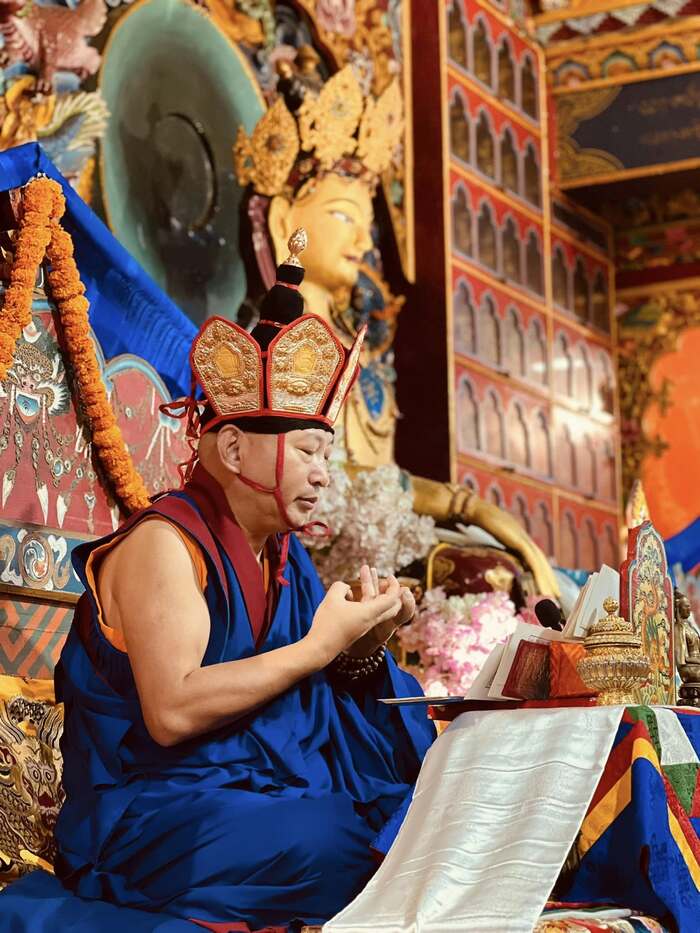
The main point is that in the past, everyone focused solely on studying the philosophical texts of their own tradition and did not examine or understand the textual traditions of other schools. As a result, by knowing only their own texts and not appreciating the qualities of others, disputes arose.
Nowadays, if Bön followers examine the textual tradition of the Buddhists, they will come to know what they're all about. Similarly, if Buddhists examine the Bön textual tradition and lay out what they refute and what they accept, this approach will become a cause for unity.
If we don't examine each other's texts, each of us holding on to the mentality of, "If it's my mother's cup, it's clean," the time will never come for us to have unity. Nowadays, as much as possible, try to examine and understand each other's textual tradition. At such a time, we have come to enjoy unity as much as possible.
Everyone seems to have elaborate morning routines these days—affirmations, yoga, smoothies, endless "self-care." What does a genuine Dharma morning practice look like, stripped of all the contemporary noise?
When we talk about how to put Dharma into practice, when you wake up each morning, try to generate the positive thought: "Today, I will not bring harm to anybody, and I shall examine if I can be of benefit to someone."
Having generated such a thought, then whatever work you yourself do, from the beginning to the middle to the end, will be done with the motivation of being of benefit to even just one other person. This will, without doubt, be of benefit, and then, your life will come to be a happy one.
On the other hand, if you wake up in the morning angry with someone, thinking, "I definitely need to do something to them," and you stay obsessed with such bad thoughts, that will bring lots of unhappiness to you and to many other people as well.
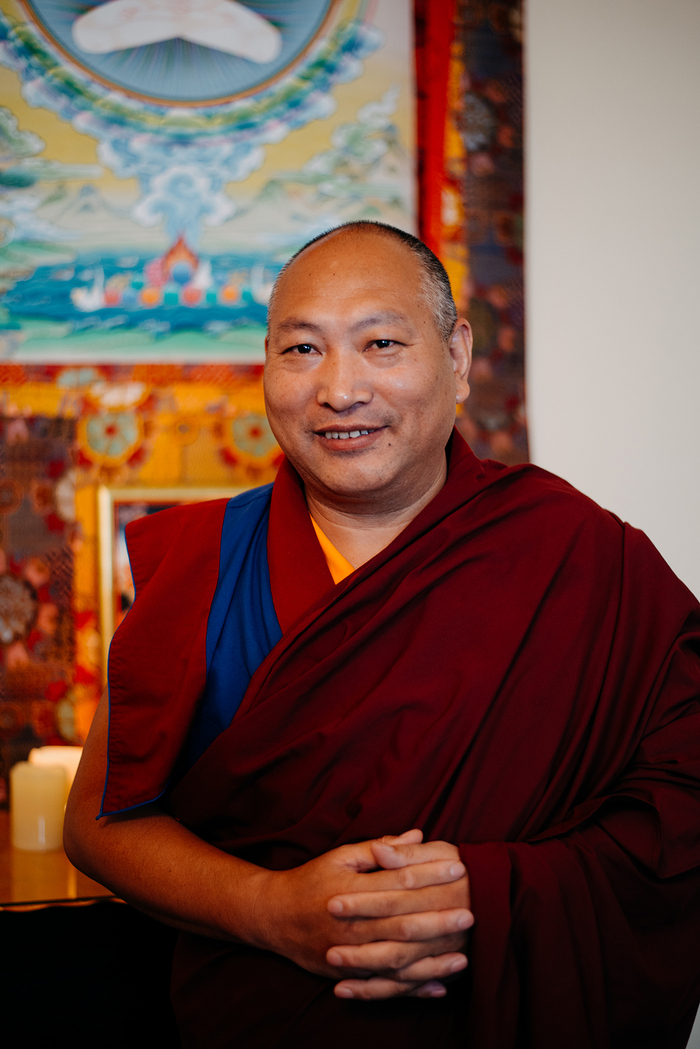
Whoever a person may be, they are simply someone who wishes for happiness and does not wish to experience suffering. When we talk about each person's wish for happiness, it mainly depends on their ability to be understanding and to reflect through analytical meditation.
For instance, suppose somebody speaks to us with harsh words. We have to stabilize our mind in meditation and can check whether or not there is some kind of reasoning behind what they say. If there is a reason, then each of us should be understanding, and our minds can be open.
If some arrogance rises up inside of us, then try to generate the opposite—which is to generate love. If we live like this, we see how it is so important to be understanding with each other. And if everyone lives like this, then there really is some hope for there to be harmony and friendship.
Your Holiness, thank you so much for your time and for sharing your wisdom, and especially for your answer to this last question, which offers much-needed and timely advice for the world.