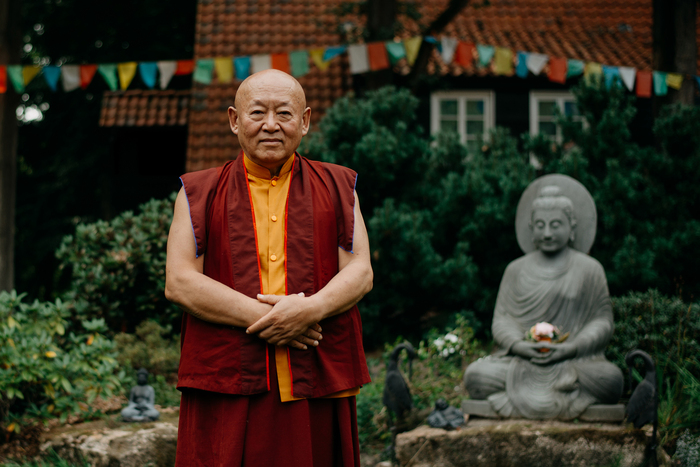
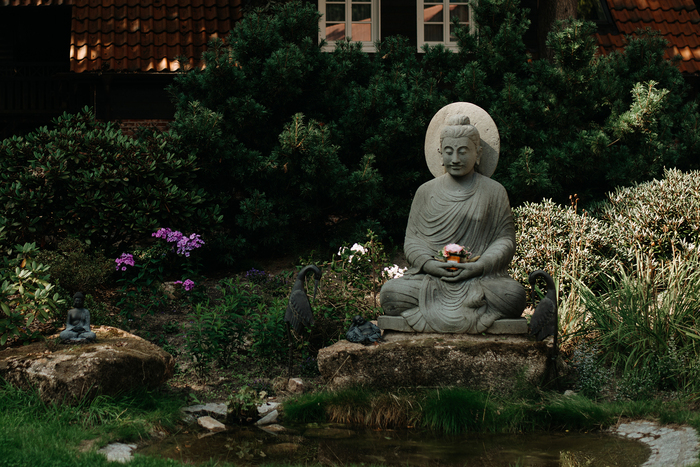
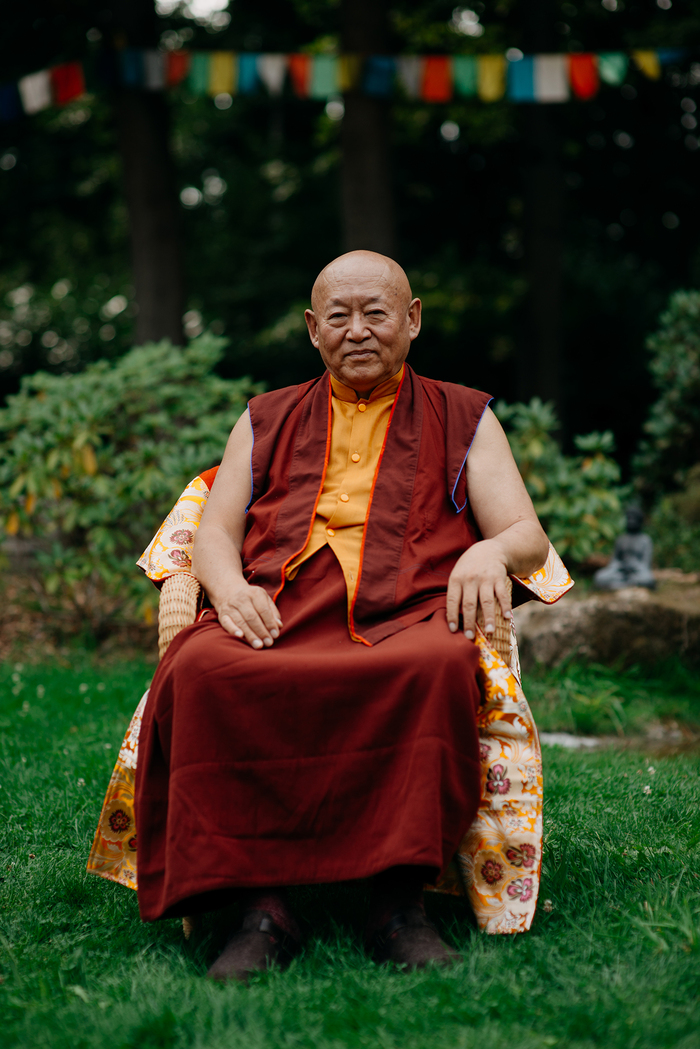
It is a warm summer afternoon, and after quite a few hours on a train from Berlin, Dr. Berzin and I arrive at the Milarepa Retreat Center in Schneverdingen, a quiet forested town in northern Germany. The center's gardens are in full bloom, and the birdsong, the scent of grass, and the occasional distant bell from the shrine room bring a sense of peaceful remove from the ordinary world. Immediately we decide to film right here, in the garden. It feels like an appropriate setting in which to meet one of Tibetan Buddhism's most respected living teachers.
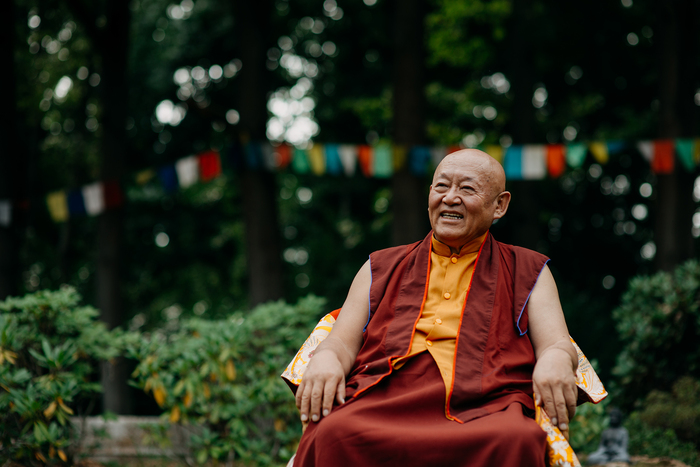
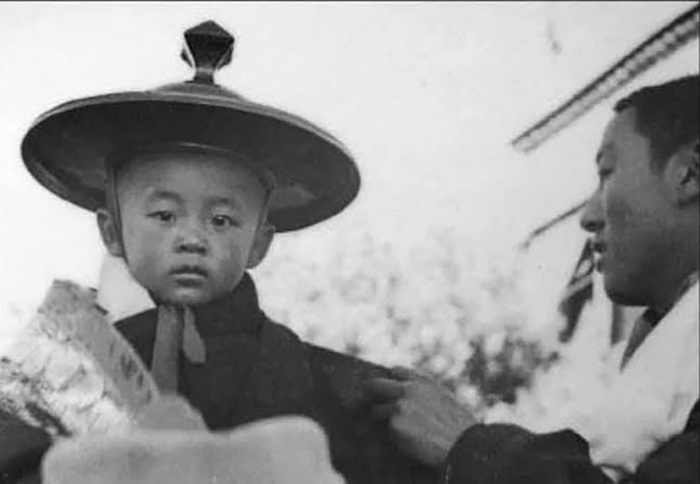
His Holiness Drikung Kyabgön Chetsang Rinpoche arrived in Europe in the midst of a busy international teaching schedule, and graciously agreed to sit with us for an interview. Though his life story includes experiences few could imagine: recognized as a reincarnate lama at the age of four, surviving the Chinese occupation and Cultural Revolution, making a daring escape across the Himalayas in 1975, with some shifts at McDonald’s thrown in after arriving in the United States. Yet, he carries it all with a lightness and calm (and laughter!) that is immediately disarming.
As the 37th throne-holder of the Drikung Kagyu lineage, Chetsang Rinpoche oversees a network of over 200 Dharma centers worldwide, along with hundreds of temples and monasteries in Tibet. He has also become an increasingly prominent voice on environmental issues, insisting that Buddhist ethics demand not only prayer but concrete, compassionate action in the world. We began, as seemed natural, right at the beginning, with the life he was born into, and the extraordinary journey that brought him here. Enjoy!
Study Buddhism: Your Holiness, you've lived through extraordinary circumstances — born in Lhasa, recognized as a reincarnate lama as a young child, then years under Communist rule before your escape across the Himalayas. Could you tell us something about that journey and how it shaped who you are?
Chetsang Rinpoche: My main homeland is Lhasa, Tibet. I spent the first thirteen years of my life in the old Tibetan society, before 1959. After 1959, until the age of 27, I was under Communist control. Then I came out in 1975 and spent three years with my parents in the United States. After that, I came back to India, because we have most of our temples and monasteries in Ladakh.
I stayed there and did about ten years of retreats, and I have remained there since – almost 40 years. I stay mainly in our education and meditation centers. Up to now, we have 200 centers around the world and about 200 temples and monasteries in Tibet. We started building in 1979, and continue even up to now. Now, in the last few years, there is already a second generation of people working, so I have a little more time for myself. These days, I'm also mainly working internationally, with Buddhism and also the environment. Most of the time, I'm outside!
Nowadays, there is a strong tendency to mix up religion and politics, but you have always been careful to distinguish between Buddhist teaching and political affairs. Why is that distinction so important to you?
Buddhist practices, culture, and politics are very different things. You have to know this – you cannot mix them together. There is not much to say except that this is very important to understand.
What Buddhist teachings or practices do you find most useful for cultivating peace and harmony in everyday life?
If you have a stable foundation, everything will go well. In the office, you'll get along well with everyone. Your boss will be happy, your friends will be happy, and your work will go very smoothly. At home, if you're angry and don't have a peaceful mind, you won't be happy, and your family also won't be happy. If you have love and compassion, everything will be very lovely.
To cultivate this stable foundation in a very simple way, I often refer to the Ānāpānasati Sutta – which, interestingly, isn't found in our own Kangyur (the collected translations of the Buddha's words in Tibetan), but is preserved in Chinese and is also taught by teachers such as Thich Nhat Hanh. "Āna" means breathing in, "apāna" means breathing out, and "sati" means mindfulness. This practice actually encompasses the entire 37 Bodhisattva Practices and the Noble Eightfold Path. I think this is very good as a daily practice for anyone.
What do you see as the most serious negative tendencies in contemporary society?
Modern society has real problems. In the past – in Tibet, for example – when a child was born, it was cared for in the mother's home. At any time, you could call for your mother. You always felt very safe because she was always with you, so you grew up feeling happy and secure.
Now, in modern society, parents don't have time as they have to work. Children have to be put in kindergartens, and although these places care for the children physically, the children probably don't feel very secure in their minds. I think many problems start from this.
Also, today there are so many TV programs and commercials full of artificial, fake things. Materialism has become too strong. There’s just too many advertisements, too much desire and competition. With this, it's impossible to find contentment. No matter how much you have, you still want more, more, more. You can never be satisfied.
What is important now is to try and find balance. We shouldn't overdo anything. Just as the world needs balance among its four elements – if one becomes too strong, the planet can be destroyed – so too our body and our society need balance. When the body's elements are balanced, we are healthy; when one has a problem, we become sick. In our daily life and in society, we must have balance.
You just mentioned the planet. Can Buddhist teachings help with the enormous challenge of climate change? It seems like the world urgently needs something more than prayer.
Exactly. We need action. Prayer alone is not enough. I always say that we need to bring the practice of the six paramitas, the six perfections, into society. Wherever people are suffering, we should go there and help, with love and compassion. That is the real practice of love and compassion, and that is what we need to do in our society and for our planet.
For someone new to Buddhism, what teaching do you think is most important to understand first?
When you begin to study Buddhism, I think you should first emphasize the practice of impermanence. Everything that is born has to die. Everything you build will one day fall down. Everything you collect will eventually be spent. Everything that gathers will one day separate. This is our daily life. Understanding impermanence is very important not just for Buddhists, but for everyone in the world.
Young people, especially those in school, never think about impermanence. Then exams come, and some people fail – even just by a few points – and some students even commit suicide. This is happening now. Exam results, relationships with friends, girlfriends, boyfriends, all of that is impermanent. When you are older, you might get a good job, but you can also lose that job.
I remember about fifteen years ago, I received a call from a young woman in her twenties in Germany. She told me she had terminal cancer and would die within a month. She could not accept it, which made everything so much harder. People never think about impermanence because it is difficult to do, right?
So, I say: look around your neighborhood. There will be people younger than you who have died or had accidents. There is no guarantee. If you think about impermanence often – at the beginning of your studies and throughout your life – you will suffer less and will be able to face any challenge that you encounter. If you never think about it, when something suddenly happens, you will suffer a great deal.
Could you give us a simple and accessible explanation of one of Buddhism's most central teachings — dependent origination?
The Buddha was once in Rajgir, speaking with Shariputra and Maitreya. In one sutra, the Śalistamba Sutra, the Rice Seedling Sutra in English, the main subject is the twelve links of dependent origination. It opens with a few remarkable lines:
"Whoever sees interdependence, sees the Dharma.
Whoever sees the Dharma, sees the Buddha."
And then it explains what interdependence actually means:
"Because there is this, there is that.
Because this grows, that grows."
Everything is interdependent. The whole universe exists in this way. The planets, the sun and moon, water, all of it is connected. Then people came, and villages formed. From there came education, schools, teachers, and eventually Dharma practitioners. Even from a scientific and ecological point of view, everything depends on everything else. This is the teaching of dependent origination.
How should Buddhist rituals be adapted for Western practitioners? Is it necessary to preserve Tibetan language and style?
For Buddhist practice in the West, it is not necessary to use Tibetan language and traditions, or to chant everything together in the traditional style. That is not essential. Each country has its own history and culture, so people should integrate their own culture with Buddhist practice.
Here at this center, we do all our practices in English. Of course, there is a Tibetan version, but we use English, and the musicians are all Westerners. Even if we have twenty-five Tibetan monks present, we let the Westerners lead the rituals. Some of the prayers, offerings, and mantras we sing with Western melodies. This is needed because it makes people feel very good.
Simply copying a Tibetan ritual in a Western context, I don't think that is very beneficial. The most important thing is loving-kindness. Love and compassion. Everything else is a vehicle for that.
Finally, Your Holiness, could you explain yidam practice? For those unfamiliar with Vajrayana, it can seem mysterious or even strange.
Usually, we say that sutra is the causal vehicle and Vajrayana is the fruition vehicle. In sutra practice, we encounter the afflictions of emotions, and we try to avoid them or chase them away directly. It is like growing a plant and cutting the top off.
In Vajrayana practice, however, the aim is to dig it out from the root. In other words, Vajrayana is transformation. Emotional afflictions are not simply to be rejected. Instead, we have to transform the emotions themselves.
The main point of yidam practice is to transform yourself. If your ego is not transformed, then the root of samsara remains. So, the central purpose of yidam practice is to turn your ego into the wisdom deity, into an enlightened being. And this is not only about an external form: when you practice, the enlightened being's qualities of body, speech, and mind, which we also innately have, are to be cultivated within yourself. The key to yidam practice is to turn our ego into these enlightened qualities.
Thank you so much, Your Holiness, for taking the time to speak with us on this beautiful afternoon, and for sharing your wisdom so openly and generously.