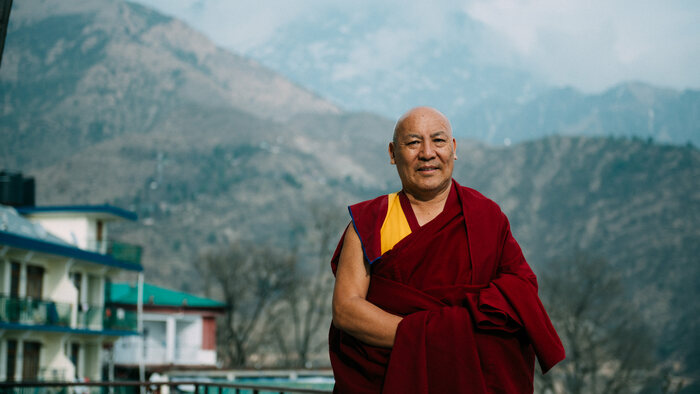
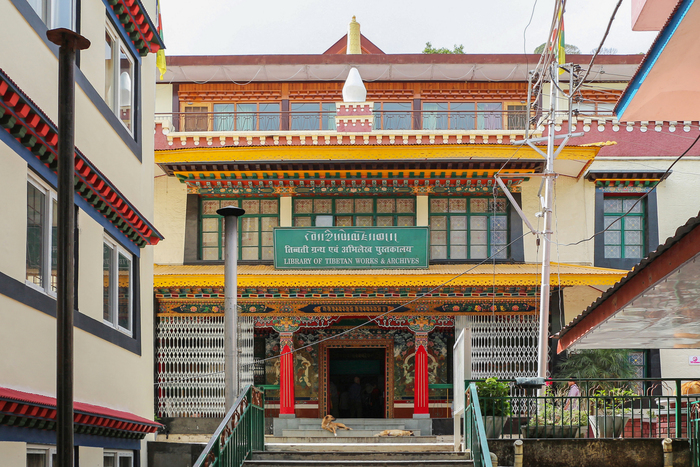
If you’ve been to Dharamshala in winter, you’ll notice that it has a particular stillness to it. There’s mist clinging to the surrounding mountains, prayer flags fluttering in the wind, while the air is crisp and cool, a much needed respite from the long monsoon season. We've arrived at the Library of Tibetan Works and Archives, an institution that has become a cornerstone of Tibetan Buddhist scholarship in exile, and we're about to interview one of its most prominent figures: Geshe Lhakdor.
For sixteen years, Geshe Lhakdor served as the translator for His Holiness the Dalai Lama, traveling the world and rendering some of Buddhism's most profound teachings into English. Beyond translation, he has also been at the forefront of remarkable initiatives that attempt, successfully, one might add, to bridge ancient wisdom and modern science, including the pioneering Science for Monks program, which brings scientific education to monastic institutions across India. Today, as Director of the Library of Tibetan Works and Archives, he continues his work of preserving and sharing Tibetan Buddhist culture and philosophy with the world.
What strikes you immediately upon meeting Geshe Lhakdor is his directness and clarity. He answers all our questions with a certain precision and a systematic approach that appears to reflect his decades of rigorous philosophical training. But it’s not dry or academic and boring – he speaks in a way that makes profound concepts accessible and practical. And the proof truly is in the pudding. A video of his explanation of emptiness in 90 seconds has consistently been one of our most popular on our YouTube channel, and this very clip was included in Oxford University Press’ Invitation to World Religions.
In our conversation, Geshe Lhakdor shares insights on what meditation actually is (hint: it's not just sitting quietly), why even non-Buddhists should study Buddhism, and what it was like working closely with one of the world's most revered spiritual leaders. He also offers invaluable guidance for those seeking to study Buddhism, including the crucial qualities to look for in a teacher and whether learning Tibetan is necessary. Enjoy!
Study Buddhism: You've been instrumental in bringing science education to monasteries and nunneries across India. What motivated you to further this integration of scientific study into traditional monastic education?
Geshe Lhakdor: We now have a lot of programs teaching science to monks and nuns in monasteries and nunneries. The reason is quite simple. Science talks primarily about the physical world. But Buddhism’s primary focus is on mind management or mind training.
As human beings, we have a body and also a mind. So, it is important to take into account both of these two important features of human life: the physical and the mental. Moreover, we have all benefited so much from scientific inventions, technological products, medicines, and so forth. There's no question at all about their usefulness. But, at the same time, a mind that is not positive, but negative, has also invented destructive nuclear weapons.
Technology, science, and religion are all inventions of the human mind. If the mind doesn't have a holistic outlook, the complete picture, and especially if it doesn't have a universal sense of responsibility, then the mind can go into all sorts of negative directions. The mind, at the end of the day, can become very destructive, just as we are seeing today.
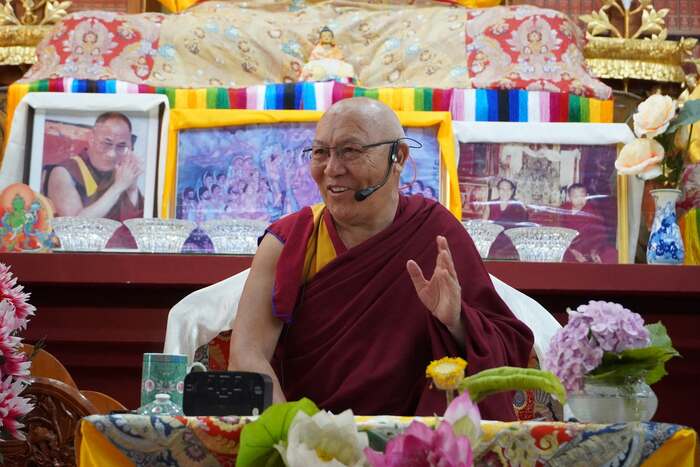
You mentioned that science focuses mainly on the physical world, while Buddhism focuses on the mind. How, then, do you see the relationship between science and Buddhism?
When we talk about the connection between science and Buddhism, it's really like the connection between the mind and the body. I once read a book by a scientist, her name is Renée Weber. She said that the subtler we go on the physical level, the closer we come to the mind. This shows the connection between the mind and the body. The body is possible because of the mind. The mind influences the body, and its energy is sent throughout the body, which then makes movement.
I’ll give you a small example. We have the four elements within us – fire, water and so forth, and all of these are related to the external four elements. Now, imagine that the external four elements are polluted, just as is happening today. The food we get from those external elements, the medicine that we get from those external elements, they are all polluted. With this kind of external environment, we are going to suffer. This clearly shows the connection.
The Latin word for science is “scientia,” which means knowledge. Science basically agrees with Buddhism that we are suffering. Here, we are primarily talking about physical suffering. And it says that most of our physical suffering comes from not having knowledge. For instance, if you have knowledge, you don't have to suffer in the heat; you can use air conditioning. That's why it was invented. If you have the knowledge of producing electricity, you don't have to sit in darkness. So, with this idea in mind, all of these different inventions were made. They have really made a lot of difference; we’ve made a lot of progress.
Similarly, in Buddhism, we say that the root cause of all our problems is ignorance. Again, that means if you have the knowledge – and here we are talking about wisdom – then you can remove many of the causes of suffering, and you don't have to suffer. So, the idea is very similar. It's the focus or emphasis which is a little bit different: science focuses more on the external, while Buddhism focuses more on the internal.
You distinguished just now between knowledge and wisdom. How do we move from one to the other?
Most of our suffering originates from ignorance. The difference between knowledge and wisdom is that knowledge is not necessarily based on deep experience, while wisdom is very much related to deep experiences. But initially, we have to have knowledge. That knowledge has to be gained through a systematic process. First, we listen to our teachers or read a book, and this is the step we normally call “listening to the teaching.” And this step is very important, but it is not enough.
A good example is, let’s say, like somebody who is really thirsty and who has no idea where water is available. They need to get that information from somebody, telling them that water is available two kilometers or whatever from here. So, that part is the hearing, listening. But just by hearing that information, their thirst will not be quenched. They need to actually walk two kilometers! What that means is that after hearing, just like having to walk two kilometers for water, we need to think for ourselves about the truth of what we have heard from our teacher, or what we've read in books. Through reflection and thinking, we're able to develop the conviction, “Yes, it really seems true.” To be able to get that conviction is very, very important. So, after walking two kilometers and reaching the water, it’s like now being able to see the water with our own eyes.
But still, if we don't actually drink the water before us, our thirst will not be quenched. Similarly, we might have developed conviction through thinking, but now we need to get completely soaked in it. We have repeatedly to habituate ourselves with this conviction so that it becomes part of our very way of thinking, our way of acting. This is what we actually call meditation. Meditation is simply getting habituated. If we're habituated to it, then compassion will come automatically. Loving kindness will come automatically, simply because it's part of our thinking.
You said that meditation is habituation, but many people still have this idea of meditation as simply sitting quietly or completely emptying the mind. So, what is meditation actually?
Meditation is definitely not just sitting there doing nothing. Meditation is actually doing! Not only doing, but meditation is very similar to playing sport. Normal people think playing whatever sport it might be is not hard work, but actually, so much effort is needed to play. More importantly, meditation is not just sitting in a corner, closing your eyes and not thinking about anything. Meditation, as I mentioned just now, basically means getting habituated.
But, habituated with what? Not with negative emotions, because we are already habituated with them. So, it’s about getting the mind habituated with positive ways of life, positive ways of thinking. This idea of meditation is not only found in Buddhism. If you look at some of the works of Aristotle and Plato, they also clearly mention that you become what you repeatedly do. Meditation is something that you repeatedly do, and you become what you repeatedly do.
Now, this has very clearly been proven with today's modern science. There is actually not much difference in the number of brain cells that young children and grown-up adults have. The only difference is in terms of the connections, and how many connections we have made. Therefore, the more effort we put into making the right connections, positive connections, the more we become that. That is habituation, and that’s what meditation is all about.
In the same way, the concept of emptiness is often misunderstood. Can you clarify what it actually means?
The word emptiness in Buddhism is not equal to nothingness. It’s important to note that the mathematical concept of zero and the philosophical concept of shunyata, that is, emptiness, both originated in India.
Let’s look at the mathematical concept of zero. Zero seems to have no value, but it is actually the foundation of mathematics. It's only because there is zero that we can have ten, twenty, one hundred and so on.
Similarly, emptiness is not equal to nothingness. Emptiness means empty of independent existence. Let's make it a little bit clearer: things exist. If things exist, there are only two ways of existing: dependent existence or independent existence. There's no third possibility. These two are mutually exclusive.
Now, things are dependent on causes, conditions and so forth. Therefore, there is no independent existence. This lack of independent existence is called “emptiness.” Therefore, emptiness and dependent origination are two sides of the same coin: due to dependent origination, there is no independent existence.
For someone totally brand new to Buddhism, how would you suggest they begin exploring the mind?
The best place to start is to go within yourself.
And the interesting thing is, whether you are well-versed in the notion of mind or not, we all talk about mind and body, everybody does. So, there is this acceptance that the mind exists. Now, based on this acceptance, you need to spend a little bit of time to find out what this thing we call mind actually is. For that, you need to go inside.
You might call it meditation or whatever, but you do a little bit of contemplation, a little bit of inner reflection. Sometimes, I prefer referring to the mind as a kind of energy because our mind is very much related to the winds, or our internal energy. And this is something that, through contemplation, you can feel.
Then, through that, you’ll firstly see how through this kind of effort you can perceive a little bit of the mind. Then, secondly, you’ll see how much control you have over the mind in doing the right thing or the wrong thing. Then, it's so interesting! You realize, “Oh yes, I can do it! I am the maker of my destiny. I can do this and do that.” There, you can see the power of the mind. So, that's the way.
Normally, the mind has to always have an object to chase. Just don't chase. Don't try to chase the object. Don't think about what has happened in the past, don't think about what is to come in the future, but just simply try to maintain being in the present. Then, you will develop this feeling that there's so much space to do anything.
Buddhism has become increasingly popular in the West. Why do you think that is, and what makes Buddhism distinctive?
Buddhism has become very popular, and one reason may be due to teachers like Thich Nhat Hanh or His Holiness the Dalai Lama, and other such great teachers.
But another reason is because of the teaching itself. The Buddha's teaching says, “Don't follow blind faith, don't follow me because I'm famous, but just like a goldsmith judges gold by cutting, rubbing and burning it in fire, check.” So, whether it's an obvious phenomenon, slightly hidden phenomenon, or completely hidden phenomenon, we can just use our common sense, and experiment and judge for ourselves. And through that, if we find that something useful, then we can follow it.
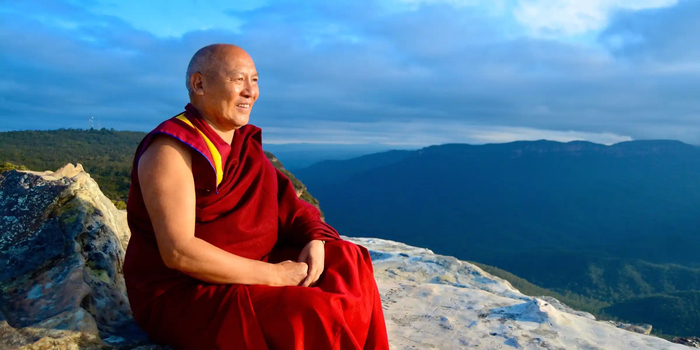
That's not only a challenge, but it also gives people confidence that it really looks like this is a religion which has the confidence to say “check.” Yes, in Buddhism we also talk about faith, but in the development of faith, it primarily says to develop the type of faith of the intelligent people. This means faith based on scrutiny and judgment, not just blind faith. That goes very well with today's scientific world. And that's why so many leading scientists are now having so many discussions with Buddhist scholars.
One of the special features of Buddhism is that the teachings on love and compassion are grounded not only in reality, but in deep philosophical study. It's saying, look, if we want to flourish and be happy, then learn to live in accordance with nature. If we try to act against nature, we’ll be the ones who suffer.
When Buddhism talks about suffering, it is not something just invented by the Buddha. It's something that is a law of nature, something that we all have to experience. No one can deny this. Similarly, when Buddhism talks about the transient or impermanent nature of things, that’s also not something simply invented by the Buddha. In the same way, interdependent origination and emptiness are laws of nature. Buddha says that these are unavoidable features of existence so we better accept them, and if we live our life accordingly, we will be happy.
For those who want to study Buddhism seriously, what's your advice on finding a teacher and beginning their studies?
There are a lot of people now coming to study Buddhism, and they're serious about it because they see the worth and importance of Buddhism. It's really benefitting them. It’s not only random individuals, but university students, scholars, researchers, countless people are coming to do more rigorous studies.
But I want to say to those who are interested in studying Buddhism that it is not necessary to come to India. What is important, at least especially in the beginning, is to find a qualified teacher. If a qualified teacher is available, anywhere, then go there. It's not necessarily in India. Really, a qualified teacher is important because they can explain to you something you can't get from a book. Books provide very superficial knowledge. But through experience with a qualified teacher, each and every word comes alive.
So, we should rely on a qualified, experienced teacher. Not just any teacher, but a really qualified one. I keep repeating myself to make a point! A qualified teacher is someone who practices what they teach. That's very, very important.
For those who are looking for a teacher, if they just want to go to some lectures or talks, then there's not a big problem. But if you want to accept that person as – we use the term “root teacher” or “spiritual teacher” – there you are making a bond. A special bond. A spiritual bond. So, before you make this spiritual bond, take your time. Don't rush, just like a dog finding a lump of meat! Don't rush like that. Take some time.
Many qualifications are needed for the spiritual teacher. But there must be at least three present. One, the teacher should be compassionate, so that there is no risk of the teacher exploiting you, taking advantage of you, which happens today! So, compassion is important. And the second is that of course the teacher must have more knowledge than you, otherwise how can they teach you? And the third, they should be someone who is always ready to undergo some hardship or spend time explaining things to you. At least these three qualities should be there, but especially that first one of compassion. This is very, very important.
Is learning Tibetan necessary to really understand and practice Tibetan Buddhism?
Oh, that depends upon your age. If you are young, then studying Tibetan language is very, very important, because as I've just said, you need to study from a qualified teacher, and not all of these speak other languages. Also, if you're able to go to the root source, the language itself, then you'll be able to understand everything much better than using an equivalent modern term or language. So, that is very important.
But, if your age is a little bit not too young, then luckily these days, there are many good translations available. Maybe, instead of wasting time, I think you should directly study those teachings in whatever language it is available in.
Why is studying Buddhism important, even for non-Buddhists?
I think the study of Buddhism is important for two reasons, both for those who are Buddhist and those who are not Buddhist.
For a Buddhist, of course, the very reason they become Buddhist is that they see some benefit in it. But it's not enough just to show initial interest and then not to understand the deeper philosophy. So, they should study, they must study.
Even for those who are not Buddhists, as we talked about at the start, most of the studies in the world today are primarily related to external, material studies. However, Buddhism is focused on internal development. And actually, the greatest difficulties that we face today are not so much about just material poverty, but rather mental poverty. Unless we know how to manage our mind through meditation or mind training, or whatever we want to call it, then it doesn't matter whether we are very rich or whatever. Each and every one of us is bound to go through this or that problem through one's life journey. And when facing those problems, if we have no inner resources, then our material resources will not come to help you. Therefore, at the end of the day, whether you like it or not, the most important thing is training the mind.
You worked closely with His Holiness the Dalai Lama for sixteen years as his translator. What did you learn from that experience?
I had the privilege of working with His Holiness for 16 years as his translator, and I was lucky to travel with him to so many different countries.
We Tibetans give him the title “Ocean of Wisdom,” and we believe him to be the manifestation of the bodhisattva of compassion, Avalokiteshvara. But even if you see him as an ordinary person, one of the few things that is really striking is that he's totally, totally committed towards alleviating the suffering of other people. That commitment is there; you can always see it.
Secondly, he never pretends to be something he is not. He always says, “I'm a simple Buddhist monk.” Despite so many people putting him at the level of a god, he always says, “No, I'm exactly like you, I'm nothing special.” That humility is there. Otherwise, when normal people get this kind of recognition, they become crazy. They pretend that they are a creator. Whether they're a political or religious leader, they start doing many stupid, mad things.
His Holiness is revered not only as a spiritual leader, but also a political leader. Now, he's already devolved his political power. Yet there are people who wouldn't hesitate to kill people to get this kind of title or power! So here again you can see the difference.
Can you tell us about His Holiness's work on secular ethics?
Even back when I was working in his office as his translator, he was already very concerned about the degeneration of human values everywhere.
Therefore, he started writing these smaller booklets like Compassion and the Individual, A Human Approach to World Peace, Global Responsibility and so forth. And then gradually he wrote the book Ethics for the New Millennium. Then, as an expansion to that, he wrote this book, Beyond Religion.
Now, he has asked me and some of my friends to work on a project compiling books and probably to start an institution to promote this idea of secular ethics. This phrase “secular ethics” is actually based on the Indian Constitution. India has a secular constitution which does not favor any religion but is also not against religion. In some places, people seem to think that secularism is a little bit against religion. But His Holiness is not talking about being against religion or things like that. So, that is the concept.
Secular ethics, or universal values, or whatever term we use – they must be based on common sense, common experience, scientific findings. It must be evidence-based, nothing to do with metaphysical concepts. His Holiness is working so hard to promote human values, not through religion, but through common sense and scientific findings. Because if we use religion, well, which religion? And out of the seven billion human population, at least more than one billion of the human population are non-believers. So, what we need is a way of life and values that are applicable to everybody.
What are these fundamental human values that you're talking about?
I would say that love and compassion are some of the most important human qualities, because if you look at the very structure of our physiology, you see that we are very much dependent on love and other's care for our nourishment and flourishing.
I normally give this example: immediately after birth the first thing a child does is cry. By crying, the child is not asking for a lengthy discourse on Buddhism or any religion. The child is asking for somebody's unconditional love. This kind of unconditional love, this is a kind of basic spirituality, basic human goodness. These are the human values we need to promote.
Think about it carefully: each and every individual loves themselves, and each and every individual, despite certain limitations, is trying their best to do something for themselves. For instance, you look after yourself, you feed yourself, you sleep, you take care of your clothing. Day in and day out, you take care of yourself. And if somebody turns up out of the blue and asks a very strange question, saying, “I saw you taking such good care of yourself. Why are you taking such good care of yourself?” Then the right answer will be, “I take care of myself because I want happiness and do not want suffering.” It's not because you're a professor or scientist or a great teacher or something like that. The correct answer is simply that, “I want happiness and do not want suffering.”
If that is the correct answer for you, then similarly others also want happiness and do not want suffering. And you don't live in a vacuum; you live with other people. So, the more you care about others, the more you will be the one who receives the benefit. It's actually very simple logic. It's for our own good that we need to take care of other people, sentient beings, the environment, and so forth.
That was beautiful! Now, as we conclude, what final message would you like to share?
I would say, life is short. We don't know how long we are going to live. It's not certain that young people will live longer, and that old people will die sooner. There's no definiteness. Therefore, we need to live this life in such a way that even if we are unable to help others, we don't harm others.
Thank you, Geshe Lhakdor, for your time and for making so many profound concepts accessible to us today.