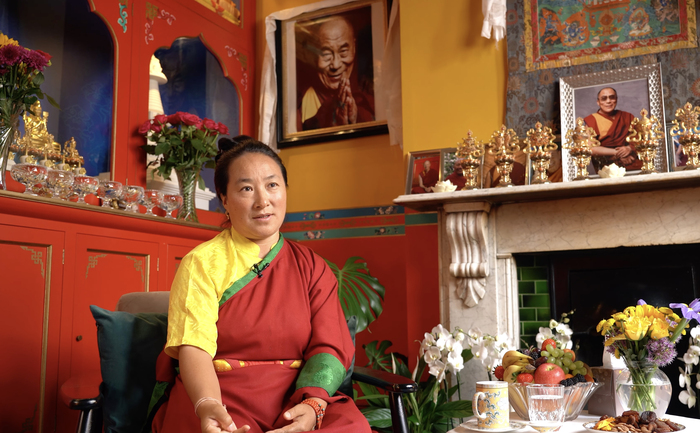
It's early morning at Jamyang Buddhist Centre in South London, and although it’s May, outside is rather cold and the streets are still quiet. I’ve arrived well ahead of schedule, partly to set up the cameras and partly to settle my nerves. This interview has been difficult to arrange, and until just a few hours before, it was unsure whether it would go ahead at all.
Inside the beautiful and intimate shrine room situated behind the main gompa at Jamyang, the morning light starts to filter through the windows, casting soft light over the golden statues, water bowls, and fresh flowers. I’m setting up for what promises to be an extraordinary interview—checking cameras, adjusting microphones, reviewing our questions with Geshe Tenzin Namdak [read his interview here], who will kindly translate – knowing that I’m about to speak with someone rather special.
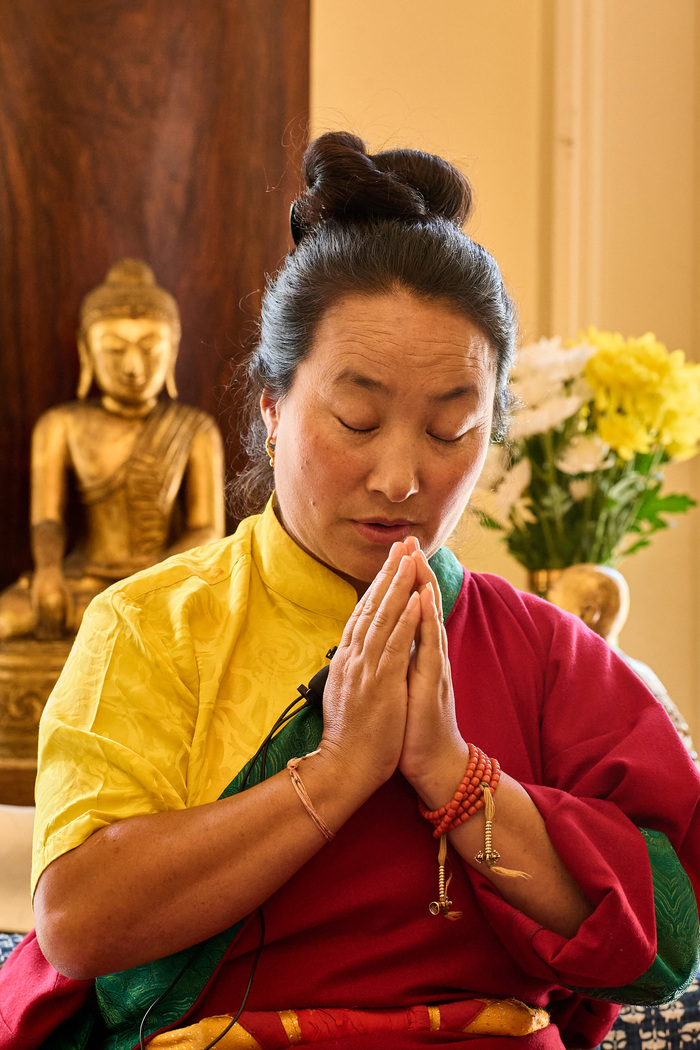
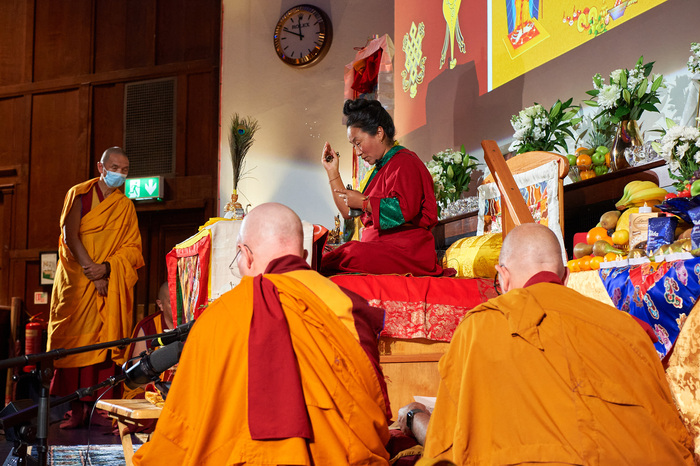
Khandro-la occupies a unique position in Tibetan Buddhism. With no formal background in Buddhist study or monastic training, she journeyed from Tibet to Dharamshala following a series of vivid visions. There, His Holiness the Dalai Lama recognized her as a self-arisen dakini and appointed her as the State Oracle of the Tenma deities – a role that involves entering trances to offer guidance for Tibet and its leaders. Despite this remarkable responsibility, she speaks with humility, often beginning her answers by reminding us that she has no formal education and “knows nothing special.”
After an hour’s wait, Khandro-la arrives, radiant, smiling, and immediately disarming. She greets me warmly and we get started on a wide-ranging conversation touching on everything from quantum physics to the nature of compassion, to the importance of His Holiness the Dalai Lama and the blessings of building stupas. Everything flows beautifully until my final question – about the Buddhist practice of liberating animals intended for slaughter. “What is the benefit of such a practice?” I ask. She bursts into laughter – fits of giggles, really. “Isn’t it obvious?” she says between laughs. “The benefit is saving lives!” Enjoy the interview!
Study Buddhism: In your view as a Buddhist practitioner, how can Buddhism and science work together to help us understand and alleviate human happiness and suffering?
Khandro-la: Firstly, I must say that I don't possess any special qualities of scholarship or monastic discipline. I haven't engaged in any formal studies, and I've never even been to school! Therefore, I don't know if what I say would be much of a benefit, but I can try to share what little I know.
From the perspective of Dharma, Buddhism is about understanding the world while holding a certain philosophical view, while science is doing the same without having a particular philosophical view. However, the foundation for both Buddhism and science is this same world that we live in, so Buddhism and science are very closely connected. Whether one is a believer or a non-believer, the simple fact is that we don't want suffering and we want happiness, and so we study and do all sorts of things to gain happiness and to be free of suffering.
Happiness and suffering are vast and profound subjects with both hidden and obvious aspects. From the perspective of modern science, which does not accept religion, the focus is primarily on addressing physical and mental suffering through the development of external material things and the study of how to achieve external accomplishments. In contrast, the cultivation of the inner science of the mind and the exploration of its vast and profound nature is found only within Buddhism. Therefore, just as the body and mind rely on each other, in the same way, Buddhism and science must also depend on each other.
In Buddhism, the teachings of scripture and realization are presented in order to establish the true nature of things and to understand the nature of reality. The true nature, or suchness, of dependent arising has been taught in this world only by the Buddha, and thus there are no teachings superior to this science of reality that the Buddha revealed more than 2,500 years ago.
Today we may have fields such as physics and psychology, but if we approach the teachings of the Buddha – conveyed through his unsurpassable knowledge, loving-kindness, and power – we can find great guidance for our daily lives. They can help create peace in the world and bring both temporary and ultimate benefit and joy. With the rapid development of external material things, along with many contributions to health and well-being, there is also a lot we can learn from modern science.
Therefore, modern science and Buddhism are interdependent, relying on each other. If we consider them as completely different and differentiate by thinking that "my psychology is the best", or "my physics is the best" then we won't be able to create peace and happiness in the society.
You mentioned that both science and Buddhism seek to understand reality to improve happiness and overcome suffering. Can you explain the Buddhist principle of dependent arising and why it's so fundamental?
Dependent arising means that all phenomena come into existence through the power of interdependence. When we speak of dependent arising, we mean interdependence. Everything we perceive, everything we do, everything related to body and mind, and all external and internal phenomena arise in dependence on causes and conditions.
There is not even a particle of existence that is truly established independently of causes and conditions. For example, a flower can only blossom if the right causes and conditions are gathered. In the same way, the Earth itself exists due to interdependent causes, relying on both external and internal factors. Based on the collection of many atoms and particles together, and through this interdependence, we can see this world.
This is the true nature of all phenomena. All the feelings of happiness and suffering must come into being according to their concordant causes. The experiments done by science have also proven this dependency: there must be causes and conditions. Science and Buddhism both recognize this fundamental truth.
Since all phenomena are empty by nature, dependent arising exists. If emptiness did not exist, it would be extremely difficult to establish or refute anything. Thus, if all phenomena are empty, then it is definitively established that they arise dependently. If they arise dependently, then it is definitively established that they are empty. Understanding the meaning of emptiness as dependent arising and dependent arising as emptiness is essential. Once you understand this, you can cut the root of samsara, cut the root of confusion, and realize the true nature of the mind.
There is nothing more important than understanding the true nature, or suchness, of dependent arising. Through that, we can understand the importance of cultivating bodhichitta, a kind heart, and enhancing the six perfections and the four immeasurable attitudes. This is something we all need, whether we are scientists, believers, or non-believers.
From the Buddhist perspective, what's the difference between compassion and bodhichitta, and how should we cultivate them?
Compassion can manifest on many different levels. One simple type of compassion arises naturally based on what we actually see with our eyes, like a spontaneous emotional response to seeing suffering in front of us. But then at the same time, we might not cultivate compassion toward wealthy or famous people, thinking they can’t be suffering. So, in Buddhism, there are ways to cultivate compassion based not only on seeing beings tormented by suffering, but also by recognising that we are all confused, and that this confusion prevents everyone from seeing reality clearly, and thus we are all suffering.
Generally, in our world, when we speak of love and compassion, they are often partial and mixed with strong attachment. On the one hand, our love and compassion are positive and beneficial, yet on the other, they’re extremely fragile – easily swayed or even destroyed by changing circumstances. In this way, ordinary compassion and loving-kindness are mixed with attachment and aversion.
Bodhichitta, on the other hand, is extremely vast and not easy to explain. It is not merely about being kind or caring or nice. Bodhi – awakening – and the understanding of emptiness, the loving mind, and the mind of selflessness all merge and pervade one another. They must go hand in hand. By realizing the excellent wisdom of the true nature of all phenomena, bodhichitta and compassion arise without limit, and then, even experiences of suffering are transformed into pure joy.
There are two aspects of bodhichitta: aspiring bodhichitta and engaged bodhichitta. Before even the aspirational thought of enlightenment can arise, there are two foundational trainings that are essential: recognizing all sentient beings as one’s mothers and remembering their kindness, and the practice of equalizing and exchanging self and others. When this understanding matures, a genuine wish for all sentient beings to attain Buddhahood naturally arises. This is aspiring bodhichitta.
Not only does one cultivate this wish, though, but by engaging in the six perfections — generosity, ethical discipline, patience, joyous effort, concentration, and wisdom — and cultivating the four immeasurables of love, compassion, joy, and equanimity, one puts that wish into action and actualizes it. When this realization becomes stable and effortless, one becomes a true bodhisattva.
You often emphasize that ethical discipline forms the foundation for developing compassion and the bodhichitta you just mentioned. How can people who aren't Buddhist understand its importance in the broader context of universal human values?
From a Buddhist point of view, explaining secular ethics — that is, ethics unrelated to any religion or belief system — can be somewhat difficult. However, from the worldly point of view, where there are many different religions, and where some people believe and others do not, secular ethics is both important and very timely.
To observe discipline means to restrain destructive states of body, speech, and mind, such as attachment, hatred, and ignorance, because these bring us suffering. If we keep discipline correctly, then we naturally move in the right direction, towards kindness, compassion, patience, wisdom, and a supremely altruistic intention.
Since every being wishes for happiness and wants to avoid suffering, no one should need to be forced or threatened into refraining from harmful actions. Observing discipline means recognizing the causes of suffering and working to reduce them, based on this very fact that all of us want happiness and nobody wants suffering. Non-virtuous actions lead to suffering, so they must be abandoned; most of us cannot do so immediately or all at once, but by relying on discipline, we can eliminate them gradually. In the same way, virtuous actions, which lead to happiness, must be slowly strengthened. When the mind becomes kind and sincere, the result is naturally happiness. Everyone wants happiness, and if we truly want both temporary and lasting happiness, we must rely on ethical discipline.
This is the best way to face conflict and disagreement, whether you are a believer or a non-believer. Our main struggles usually revolve around wealth, reputation, and status, but these alone cannot bring us real happiness. Real happiness comes from a mind that is kind, honest, and vast. To cultivate such a mind, we must practice discipline.
What are practical steps can we take to cultivate patience and inner peace, so we're not easily unsettled by other people's behavior?
There are two ways to train in patience: one is to practice patience temporarily, in the moment, and the other is to cultivate it through reflecting on the faults of anger. In both cases, the key is wisdom. Without wisdom, true patience is impossible, because impatience arises from self-grasping – our strong attachment to this idea of a solid, independent self. We have such strong attachment to the self and to the belief in true existence that we cannot practice patience and easily become impatient.
This self-cherishing attitude and the belief in true existence are both forms of ignorance. They are adventitious and delusory, obscuring our natural clarity and causing harm to ourselves and others. When we begin to recognize this and apply wisdom, we can genuinely practice patience.
When patience is guided by wisdom — when we see through the illusion of a fixed self and the fleeting nature of anger — it becomes something truly precious.
Stupas appear in many different forms across Buddhist cultures. What do they represent, and what are the benefits of building or decorating them?
The tradition of building stupas (chörten in Tibetan) originates from the time of the Buddha himself. While the Blessed One was still alive, he advised his disciples to construct stupas, particularly in places where his relics were to be enshrined, and to make offerings to them.
Later, as the Buddha completed the teachings of both the sutras and tantras, he spoke extensively about the construction of stupas and their benefits. These benefits include preventing obstacles from elemental harm or natural calamities, because everything is interdependent and temporarily dependent on one another. In addition, many great masters have also had pure visions that indicate the benefits of building stupas.
Most importantly, a stupa represents the exalted, enlightened mind of the Buddha. Therefore, when considering the fine details of stupa construction, the purpose and clarity regarding this topic are very well defined within the various philosophical traditions.
This is not about arbitrary labels or meaningless names; it is a well-founded principle based on scriptural and logical reasoning. All of this includes the teachings on mandalas, the construction of representations of the Buddha's body, speech, and mind, as well as the generation and completion stages of tantra. All of these practices are deeply connected to both bodhichitta and the view of emptiness, and as their power and impact grow stronger, they ultimately lead to realization within the Vajrayana, the Secret Mantra Vajra Vehicle.
And finally, you have a close relationship with His Holiness the Dalai Lama. Could you share your thoughts on why he is so important for the world today?
As I’ve mentioned, all sentient beings wish to avoid suffering and find happiness. If we look broadly, across the six realms of existence, all beings share this same wish: just as we do not want suffering for ourselves, others equally do not want to suffer. His Holiness the Dalai Lama has taught and continues to teach the complete methods and practices for cutting through the very root of suffering, and in this way, he is truly precious in our world.
Because all temporary and ultimate forms of happiness depend on other sentient beings, His Holiness constantly reminds us of the supreme preciousness of all sentient beings. He teaches us to regard all beings without attachment, hatred, or bias. People who reflect upon and understand his teaching see that it brings forth immense happiness, unmistaken views, and unmistaken conduct.
In terms of religious and Dharma activities, His Holiness has established monasteries, higher monastic colleges, and retreat centers, recognizing that the foundation of the Buddha's teaching lies in a strong spiritual community. He has created places dedicated to study, contemplation, and meditation. Beyond that, he has initiated dialogues between Buddhism and modern scientific thought. Much of today’s global interest in Buddhism can, in large part, be attributed to His Holiness’ vision and compassion guidance.
It is extraordinarily rare for such a great being, a teacher like His Holiness the Dalai Lama, to appear in this world. His Holiness embodies profound wisdom and boundless compassion, which eradicate the root of suffering. He reveals the source of both temporary and ultimate benefit, goodness, and happiness. What could possibly be more precious than this?
Wow, a perfect ending. Thank you so much, Khandro-la, for your time and sharing such precious teachings with us.