Introduction
Any course of conduct has a beginning, a middle and an end. Likewise, no matter what the topic might be, a formal meditation session has preparatory practices, its actual fundamental part and what should be done to conclude it properly. It is important not to omit the first or last parts. When we prepare a meal, will there be anything to eat if we ignore gathering the ingredients beforehand or serving it out when the food is done?
The six preparatory practices (sbyor-ba’i chos-drug) are given as described in the enlightening biography of Serlingpa [as cited by the Fifth Dalai Lama in Personal Instructions from Manjushri (Byang-chub lam-gyi rim-pa’i khrid-yig ’jam-pa’i dbyangs-kyi zhal-lung), 13.a5–6]. They should be performed each morning to begin our session of meditation either on relating to our spiritual mentor in a healthy manner that we find at the beginning of Tsongkhapa’s Grand Presentation of the Graded Stages of the Path (Lam-rim chen-mo) or on any of the other presentations of the graded stages of the path. Although the first two practices are optional for additional sessions during the day, we should by all means repeat the last four, even if only in an abbreviated manner.
The First Practice: Sweeping Our Meditation Room and Setting Up Representations of a Buddha’s Enlightening Body, Enlightening Speech and Omniscient Deep Awareness
Each morning, we should clean our place of meditation carefully and conscientiously. This need not be a separate room in our house, but wherever is most conducive for our quiet and uninterrupted practice. The necessity for cleaning the room can be appreciated if we consider what we would do to prepare if we had invited to our home some important guests. Just as we would tidy the house to show them respect and make everything pleasant for their comfortable visit, likewise each day we should do exactly the same. This is because we are inviting all the Buddhas and the lineage masters to come to our room and help in our practice.
Once there lived in Shravasti a family of the brahmin priest caste whose children all died the day they were born. Immediately upon the birth of their next child, they consulted an old wise woman who advised them to have a maid take him to the side of a big road and stay until sunset and ask all holy men and women who go by to bless the infant and pray that the parents’ wishes for his long life come true. By this being done, the child survived his first day and thus was named Mahapanthaka or “Big Road.”
When a second son was born, the parents did the same. This time, however, the child was given to a different maid who was much more laxed than the previous one. She took the child merely to a little alley nearby where there were hardly any passers-by. However, the omniscient Buddha Shakyamuni, seeing that the baby would be one of his future disciples, came there himself and blessed the child. He too lived through his first day like this and was given the name Chudapanthaka or “Little Alley.”
Some years later, when Little Alley was learning to read, he was first taught the word siddham, which means “actual attainments.” However, when he could remember the first syllable sid, he would forget the second, and if he managed to recall the dham, he would forget the sid. The teacher thought he had never met anyone so stupid and, not caring to waste any more time, sent him on to another instructor.
The next one tried to teach him the syllables om bu, but the same thing happened. “Why can’t you learn like your smart older brother Big Road?” – he complained and kicked the boy out. Shortly afterwards, both his parents passed away. Big Road became a fully ordained monk and was so intelligent he quickly became an arhat. When the parents’ money ran out and Little Alley had nowhere left to turn, he went to his brother and asked for his help. Big Road took him in and then tried to teach him a four-lined verse, but after three months he could still not remember it, although all the shepherds around now could. Big Road gave up and booted the lad out.
Little Alley stood outside the walls of the monastery, wailed and cried, “My teachers kicked me out, my parents died, and now my brother doesn’t want me!” The Buddha heard his lament and went to see him. “Do not cry,” he said, “your brother Big Road may be an arhat who has gained liberation, but he does not know everything; I know best. I shall accept you into my order.”
The Buddha then gave him monks’ robes. Little Alley was amazed at his kindness, but seriously doubted if he could ever do anything. He knew nothing at all. The Buddha reassured him, “If you say you know, that is no good. However, if you admit you know nothing, that is much better because then you can learn.” He taught him to recite the two phrases, “Dirt be gone, stains be gone.” Again, Little Alley could not remember them.
The Buddha said, “No bother,” and sent him off to clean the monks’ sandals. This he could do and, by the power of the positive karmic force he created by this service, some of his obscurations were removed and he could now remember the two phrases he had been taught.
“Good,” said the Buddha, “now you must go to the temple and sweep the floor each day while repeating these phrases.” Little Alley did as he was told, but his work never ended. By the Buddha’s extraphysical powers, whenever he cleaned one side of the temple, the other became completely covered with dust. He swept and he swept, repeating these phrases year after year, and finally through all this purification he at last realized that the dirt and stains to be gone were not external but dwelt in the mind. In this remarkable fashion, he came to see ultimate reality and eventually he too became an arhat.
The Buddha was very pleased and decided to have him deliver the bimonthly teaching at a nearby nunnery. He sent Ananda ahead to announce Little Alley’s arrival. No one knew of his recent attainment, but only that he was so feeble-minded he could not remember four lines in three months. The nuns felt slighted and thought to embarrass the notorious imbecile. They announced all around that a great monk-scholar was coming to lecture. They then arranged a high throne but, on purpose, left out the stairs. He could never climb up – what a laugh it would be.
On the day of the teaching, a huge crowd gathered, and when Little Alley arrived and saw the high throne without any stairs, he knew that they only wanted to humiliate him. Some saw him fly up to this seat, and others saw him make it come down to his level, but in any case, he sat on the throne and demonstrated a wide array of extraphysical powers. The crowd was humbled, and then, on the theme of “dirt be gone, stains be gone,” Little Alley delivered an amazing discourse. Everyone developed great faith in the methods of the Buddha that someone previously so stupid could achieve such results. Thus, we can see the value of sweeping.
Mahapanthaka (Big Road) and Chudapanthaka (Little Alley) are two of the sixteen stable elders (gnas-brtan bcu-drug, Skt. shodasha-sthavira, sixteen arhats), a group of the Buddha’s disciples who became arhats and were deputed to the various directions to teach and preserve the Dharma. The other fourteen are Angaja (Yan-lag ’byung), Ajita (Ma-pham-pa), Vanavasin (Nags-na gnas), Kalika (Dus-ldan), Vajriputra (rDo-rje-mo’i bu), Bhadra (bZang-po), Kanakavatsa (gSer-be’u), Kanakabharadhvaja (Bha-ra dha-dza gser-can mchog), Bakula (Ba-ku-la), Rahula (sGra-gcan ’dzin), Pindolabharadhvaja (Bha-ra dha-dza bsod-snyoms len), Nagasena (Klu’i-sde), Gopaka (sPed-byed) and Abheda (Mi-phyed-pa).
Sweeping, in fact, is so important that to demonstrate this point the Buddha himself once swept the grounds at the park outside Shravasti, called Jetavana, “Jeta’s Grove,” where for twenty-five years he spent each rainy season retreat. This occurred when his patron Anathapindada (mNgon-med zas-sbyin) could not come one morning to perform this, his usual service.
Therefore, Pabongka has suggested that when we sweep our meditation room we repeat, as Little Alley did, “Dirt be gone, stains be gone,” while keeping in mind that the dirt and stains are our attachments or whatever obscurations we might have. Further, we imagine the broom to be the discriminating awareness of voidness. When we have finished sweeping and have tossed out the rubbish, we feel that through this awareness acting as an opponent force, we have cleared our minds of all the disturbing emotions and the naivety with which we had taken things to exist in fantasized ways. We now are confident that we will gain brilliant realizations during our meditation. Otherwise, if we simply sweep the floor, without such transforming thoughts or visualizations, we are the same as a janitor and there will be little effect. If we are too old or sick to sweep by ourselves and must have someone do this for us, we still should recite Little Alley’s two phrases and imagine we are doing it ourselves [as cited by Zhamar in A Sun to Shine Rays of Light of Positive Goodness (Byang-chub bde-lam-gyi khrid-dmigs skyong-tshul shin-tu gsal-bar bkod-pa dge-legs), 3.b4].
There are five benefits to be derived from properly cleaning our meditation room:
- Our own mind will likewise become clean and tidy.
- So will the minds of others entering the clear atmosphere of our room.
- The deities and Dharma protectors will be pleased and happy to visit there frequently.
- We will build up the positive karmic force to be reborn with handsome bodies and pleasing features in our future lives.
- We will build up the positive karmic force to be reborn in pure lands in our future lives.
A pure land is a place presided over by a Buddha and not included in any of the three planes of (samsaric) existence (khams-gsum, Skt. tridhātu, three realms). Everything is conducive there for making great spiritual progress quickly, and no one can leave until he or she has reached the point of never being reborn again in samsara.
If we do not keep our place of meditation neat and clean, but instead visualize the Buddhas and so forth in our unkempt room, we will be showing them great disrespect. Furthermore, just as His Holiness the Fourteenth Dalai Lama has explained that he washes his hands and face even before reading any book, so should we do likewise before any meditation.
It is important to keep in our meditation room the image of a Buddha. This is because seeing it daily will make a deep impression on our minds. Our admiration will naturally grow and eventually lead us to the state the image represents. And, as in the case of Shariputra, seeing a Buddha image can have an enormous effect. In a previous life as a letter-carrier he stayed one night in an abandoned temple and lit a lamp to clean his shoes. While relaxing, he noticed on the wall a drawing of a Buddha. At its sight, his mind was filled with peace and joy, and he sincerely prayed that some day he might actually meet a being like that. As a result, he was born as one of Buddha Shakyamuni’s closest disciples. Seeing such a picture then is so powerful that in the The Lotus Sutra (Dam-pa’i chos padma dkar-po’i mdo, Skt. Saddharma Puṇḍarīka Sūtra) it has been explained that even if we look with anger at a picture of a Buddha painted on a wall, it will draw us closer to his or her exalted state.
Therefore, wherever we normally meditate we should arrange, on either a table or a shelf, an altar. We represent the enlightening body of a Buddha by either a statue, a painting or both, placing them in the center; his enlightening speech with scriptural texts at the statue’s right, that is to our own left as we face our altar; and his omniscient deep awareness with either a small stupa or a set of vajra and bell to the statue’s left.
It is crucial to treat these representations respectfully as if they were these actual three enlightening faculties of the Buddha himself. Because they represent the highest purified state we wish to achieve and also those who have attained it before, we never, for instance, lie with our feet outstretched casually toward them as if we were their superior.
Geshe Potowa has said:
Those who do not keep statues or scriptures in their room do not have the problem of creating negative karmic force (sdig-pa, Skt. pāpa) by showing them disrespect. However, for those of us who do arrange them, we must be very careful.
Nowadays, when we look at our actions, instead of offering fragrant incense before our altar, we offer cigarette smoke!
Also, if we show disrespect for our texts, such as by placing objects on top of them as if they were a table, it will cause our discriminating awareness to degenerate. As Geshe Sharawa has said:
We have enough unawareness and confusion already. Who needs any more?
Thus, we never put a statue on top of a scripture or even on a shelf above our books. In fact, not even a mala rosary should be laid on top of our texts, since they represent and contain the actual Dharma measures to tame our own and others’ minds.
Also, we never place pictures of our Buddha-figures in the center of our altar and our spiritual mentors only at the side. It should be the exact way around since Buddha-figures come from our teacher. We can easily tell how much a person knows by the way he or she arranges his or her altar.
Finally, we must never be proud of the cost of our statues or thangkas nor display them to show off our wealth or impress visitors. We simply arrange our altar as best and as tastefully as we can in order to build up the positive karmic force for realizing our spiritual aims.
The Second Practice: Obtaining Offerings Without Hypocrisy and Arranging Them Beautifully
The types of offerings appropriate to place on our altar include seven water bowls filled each morning with fresh, clean water, representing the parts of our seven-limb prayer. Also suitable are flowers, incense, fruit, sweets, the first portion of our morning tea or coffee and tormas (gtor-ma). These sculptured cakes for dispelling unawareness, fashioned out of toasted barley grain and butter, are a particularly Tibetan innovation, not found previously in India. Offering such cakes, while mindful of their symbolism, helps dispel the unawareness with which we superimpose reality with mental fabrication (spros-pa, Skt. prapañca, fantasy) and then, based on dualistic appearances (gnyis-snang), cognitively take objects (’dzin-pa, Skt. grāha) to exist in impossible ways. As a substitute we may offer cookies.
Atisha had recommended that since the mountain water in Tibet is so plentiful and clean, it would be an excellent offering for the people there to make.
The eight qualities of excellent water are its being cool, delicious, light, smooth, clear, not dirty, not harmful to the stomach and likewise not harmful to the throat by causing goiter [as cited by Maitreya in The Furthest Everlasting Continuum (rGyud bla-ma, Skt. Uttaratantra), IV.48].
Dagpo Jampel Lhundrub (Dvags-po Blo-bzang ’Jam-dpal lhun-grub) has explained the benefits of offering water with each such quality as being, respectively, that we will be able to keep pure ethical self-discipline, obtain food of best taste, our bodies and minds will be serviceable (las-su rung-ba), the streams of our understanding will be smooth, our state of mind will become clear, we will become cleansed of our obscurations, not fall sick, and our voices will become melodious. Purchog Ngawang Jampa has said [as cited by Lozang Togme in Some Notes of Advice (dMar-khrid thams-cad mkhyen-par bgrod-pa’i myur-lam bzhin-khrid skyon-ba-la nye-bar mkho-ba’i zhal-shes ’ga’-zhig-gi brjed-tho), 21.b2]:
Since we are not stingy with water, it is very positive and beneficial to offer as much as we can. Although it may appear as simple water to us, the Blissfully Gone Buddhas will enjoy it as nectar.
We should keep this in mind when we make such an offering and not regard what we give as being just ordinary. In fact, we multiply the offering infinitely in our minds and visualize we are presenting the Buddhas with the most splendid and bountiful objects imaginable. This is known as the offering style of the bodhisattva Samantabhadra (kun-bzang mchod-sprin, clouds of Samantabhadra offerings).
We offer what is of most value to us, not what we regard as useless. Geshe Potowa has warned about a situation in which, for instance, we have two cakes of cheese and have kept one so long it has gone off and is unfit to eat. For us to keep the other, fresh cake for ourselves and offer the foul one on our altar while saying, “I make this offering of rapturous food,” would be completely hypocritical. We should not worry, the Buddhas are never greedy. We offer them our best food first. They accept the essence, and later we take it down and either eat it ourselves or give it to others. We never leave offerings to rot on our altar and then throw them away in the garbage.
No matter how poor we are, we should still make offerings before a humble altar. Drubkhang Geleg Gyatso had only one teacup and could not afford any offering bowls. Instead, each morning he would clean his cup well, offer tea in it to the Buddhas and afterwards ask to borrow it back to drink from himself. The next morning, he would clean it again and use it once more to make his offering.
Likewise, Geshe Puchungwa (dGe-bshes Phu-chung-ba) (1031–1106) was so poor in his youth, he made incense out of common grass and burnt this as his offering. As a result of his firm conviction (mos-pa, Skt. adhimokṣa), later in life he could afford sandalwood incense and, toward the end of his days, incense made of special rare substances worth twenty-two gold coins a stick.
The ever-practical and unpretentious Potowa would take his disciples to beautiful meadows filled with flowers, and in their minds they would all make offerings of them to the Buddhas. However, he also has warned that when we have actual offerings, we should not merely give in our minds beautiful objects not owned by anybody or only visualized, imaginary gifts. He has said, “Don’t lock all your good things away in the cupboard and give only visualized objects because you’re so cheap!”
Each morning, we set out our offerings after we have washed ourselves and cleaned our meditation room, but before we have had our morning tea or coffee.
Before filling the water bowls, made of gold, silver brass or whatever we can afford, we polish them with a clean cloth.
- Repeating three times the mantra OM AH HUNG to protect our minds from viewing this as an ordinary act, we pour some water carefully and gracefully into the first of the bowls, held stacked in our hand.
- We pour most of this water from the first bowl into the second, leaving a little on the bottom of the first, and place the first bowl on the altar to the right of our statue or image of a Buddha.
- We then pour most of the water from the second bowl into the third, leaving a little on the bottom of the second, and place this second bowl next to the first, going from the statue’s right to its left.
- We continue this procedure until the original amount of water is evenly distributed among the seven bowls and they are all set out.
- We then go back and fill each bowl to just below the brim, again going from the statue’s right to its left.
These water bowls are arranged on our altar in a straight line along the front edge of the table or the shelf that we use, with a space left between the bowls approximately the width of a grain of rice. It has been explained that if the bowls are touching, our minds will become dull; if too far apart, we will not meet a spiritual teacher in the future; if the water overflows, our ethical self-discipline will become lax; and if the water does not fill the bowls, we will become poor [as cited by Lozang Togme in Some Notes of Advice, 21b.2–3]. During mid- or late afternoon, we empty the bowls from the statue’s left to its right and, without wiping them, stack them with one leaning against the other to dry. We dispose of the offering water in an appropriate manner, such as by using it to water the plants.
In making offerings, we must be sure to avoid all hypocrisy, from the point of view of either our means for obtaining them or our motivating aim. For householders, hypocritical means refer primarily to any form of dishonesty in making a living, such as by cheating others, fixing weights and scales and so on. For monks and nuns, the emphasis is on abandoning any of the five wrong livelihoods (log-’tsho lnga, Skt. pañca-mithyājīva) used to obtain donations from patrons:
- Flattery – obsequiously praising someone in the hope that he or she will give us something
- Hints – dropping hints, for instance, that we are all out of sugar, or reminding someone how helpful his previous donation had been in the hope of getting another
- Blackmail – threatening someone by saying, for instance, that he is guilty of a particular offense, but if he gives us some protection money, he will be safe
- Bribery – presenting someone with a small gift in the hope that he will give us something more valuable in return
- Contrived manners – superficially changing our ways and pretending to act kindly toward someone or to be holy in the hope of obtaining some gain.
In such cases, it is better not to offer anything than to offer something received or bought with the money we have gained in these deceitful ways. Offerings are most elaborately made during honoring ceremonies, and the point of such ceremonies is to please the Buddhas and our spiritual mentors. How can they be pleased by our dishonesty?
We must also avoid making offerings with a hypocritical motivation, for instance, wishing to impress others so as to gain praise as a religious, devout practitioner. Therefore, it is important before we arrange our offerings to examine our motivation for doing so.
Once, Geshe Ben Gungyal (dGe-bshes ’Ban-gung-rgyal) (b. 11th century) was doing a meditation retreat in a cave. One day, because he expected a visit from his patron, he took extra care to set out more elaborate and impressive offerings than usual on his simple altar. Later, when thinking about his motivation for having made the offering, he jumped up quickly in disgust. Taking a large handful of ashes from the ashbin, he declared, “I throw these in the face of all concern over transitory things in life,” and proceeded to fling the ashes at all the ornate arrangements he had made.
Far away in Dingri, in Upper Tibet, Padampa Sanggye (Pha-dam-pa sangs-rgyas) (d. 1117) was delivering a discourse, and with his clairvoyant powers of advanced awareness (mngon-shes, Skt. abhijñā) he beheld all that took place in the cave. With great pleasure he announced to his disciples, “Ben Gungyel has just made the purest offering in all Tibet.”
Padampa Sanggye, author of A Hundred Verses to the People of Dingri (Ding-ri brgya-rsta-ma), was the founder of the pacifier tradition (zhi-byed), whose cutting-off or chod (gcod) rite to eliminate grasping for an impossible “soul” (gang-zag-gi bdag-’dzin, Skt. pudgalātmagrāha) is followed in all traditions of Buddhism in Tibet.
Therefore, without any hypocrisy, we arrange offerings on our altar as beautifully as we can. This acts as a cause for our attaining the perfect physical features of a Buddha. Moreover, we attend to the altar ourselves. If we have someone else do it for us, he or she builds up the positive karmic force, not we.
The Third Practice: Arranging a Proper Seat, Adopting the Eightfold Posture (or a Comfortable Alternative) and Taking Safe Direction and Reaffirming Our Bodhichitta Aim
The most conducive seat for stable absorbed concentration is a cushion with the back somewhat raised and placed on a wooden platform slightly elevated from the floor so as to allow for ventilation beneath. Various auspicious designs and grasses may be arranged underneath. Before taking our seat, we pay homage by prostrating three times.
When making prostration, our two hands are pressed together with fingers outstretched, and our thumbs, representing the skillful means (method) and discriminating awareness (wisdom) of a Buddha, are tucked inside our palms. We begin by touching our hands to four places: to the top of our heads, to signify our wish to develop a Buddha’s crown protrusion; to our foreheads, to develop the treasure-like curl between his brows; to our throats, to develop his enlightening speech; and to our hearts, to develop his faculties of mind.
We then prostrate, touching the ground in seven places, namely with our two feet, two knees, two palms down before us and head. It is important for our head actually to touch the ground and for our hands to be flat, not clenched. Without pausing, we immediately stand up straight and repeat this sequence three times. Pabongka has warned that if our hands are clenched or if we stay lying on the ground or if we remain bent over between prostrations, we build up a dangerous potential to be reborn either with hooves or as a creature that slithers on its belly or goes about on all fours. At the end of the third repetition, we again touch our hands to the top of our heads, foreheads, throats and hearts a fourth time, completing the three prostrations. This manner of prostrating is called “contracted prostration” (bskum-phyag).
There is also “outstretched prostration” (brkyang-phyag). This is begun as before by touching our pressed hands, with thumbs tucked in, to the same four places mentioned above and then placing first our hands and then our knees on the ground. Then we place our hands further out before us and lie face down. Finally, we stretch out our arms straight before us with our palms flat down on the ground, slightly separated from each other. Some people, once in this position, again press their hands together with thumbs tucked in, touch them once more to the top of their head and again place them flat on the ground before rising. This is unnecessary. It is better to stand up immediately as already mentioned. We do this by reversing the steps by which we stretched ourselves out.
While prostrating, we may repeat either the Sanskrit formula, “Namo gurubhyah, namo buddhaya, namo dharmaya, namo sanghaya,” or, in English, “Homage to the masters, homage to the Buddha, homage to the Dharma, homage to the Sangha.” As we go to the ground, we feel we are approaching liberation and enlightenment, and as we rise, that we are removing ourselves from samsara.
If making either of these two kinds of prostration would attract unwanted attention or would be inconvenient, such as when doing honoring practices while traveling, hand-mudra prostrations (phyag-rgya’i phyag) commonly used as salutations may also be made. We either touch to our hearts our two hands pressed together with the thumbs tucked in, or raise our right hand, either with fingers outstretched and thumb tucked in, or with index finger outstretched and all the other fingers tucked in, to the level of our nose and bow our head slightly. This last method, however, is not normally used.
In general, there are three types of homage:
- Physical homage (lus-kyi phyag)
- Verbal homage (ngag-gi phyag)
- Mental homage (yid-kyi phyag).
The first refers to such actions as the three types of prostration described above, as well as to touching a Dharma text or a statue or a picture of a master to the top of our head as a sign of respect. Verbal homage refers to such practices as visualizing numerous heads on our bodies, each with many mouths, and each offering praises to the Three Rare Supreme Gems (dkon-mchog gsum, Skt. triratna, Triple Gem): Buddha, Dharma and Sangha. Mental homage refers to such attitudes as having confidence in these Three Gems.
Ensapa (rGyal-ba dBen-sa-pa Blo-bzang don-grub) (b. 1445), a master of the Gelug tradition and predecessor of the line of Panchen Lamas, has given us a guideline jingle for remembering the eightfold posture:
The legs, hands and spine make three. The teeth, lips and tongue taken together are the fourth. The head, eyes, shoulders and breathing make four more for the eightfold posture of Vairochana.
Vairochana (rNam-par snang-mdzad, rNam-snang) is the Buddha-figure with whom we identify in order to purify our aggregate of forms of physical phenomena (gzugs-kyi phung-po, Skt. rūpaskandha, form aggregate), specifically our bodies. His eightfold posture was used by such famous meditators as Milarepa and is in accordance with the practice outlined by Kamalashila (Ka-ma-la shi-la) (8th century) in his Middle and Latter Presentations of the Stages of Meditation (sGom-rim bar-pa and sGom-pa’i rim-pa, Skt. Bhāvanākrama).
If possible, we should sit in the vajra posture – known in non-Buddhist systems as “the full lotus” – with our feet crossed and locked, resting upon the opposite thighs or calves. This is to build up the instinctive habit of sitting in the pose of a Buddha. If this is uncomfortable, however, we may sit in whatever way suits us, so long as our back is straight and not leaning against anything. Although the vajra posture is optional at this point, it is crucial when we involve ourselves in the highest class of tantra and reach the complete stage (rdzogs-rim, Skt. niṣpannakrama, completion stage) of anuttarayoga tantra, in which we strive to pierce through to the vital points of our subtle energy-system. Therefore, it is best to start accustoming ourselves now so that we can gradually sit like this without any discomfort for a long period of time.
In the vajra posture, we rest our hands on the heels of our upturned feet, which are on our thighs, with our left hand beneath our right, and with our thumbs touching each other, forming a triangle at the level of our navel. Our spine is as straight as an arrow. This is to allow the currents of energy-wind (rlung, Skt. prāṇa) in our bodies to flow freely without impediment – an essential condition for success on the complete stage. Our lips are relaxed, not pursed, and our teeth are not clenched. Our tongue touches our upper palate. This is to retain saliva, so that our mouth does not become dry, and also to prevent drooling. If there is excess saliva, we may swallow, but this position of the tongue should minimize salivation.
We keep our head bent slightly forward and down. If it is raised too high, we will be able to see too much and our minds will wander. If it is bent too low, we will become dizzy or drowsy. Therefore, we follow, as usual, a middle path, avoiding extremes. We keep our eyes half-open, loosely focused on the vicinity of the tip of our nose without straining them in an unnatural cross-eyed position. For ordinary practice, we do not have our eyes rolled up staring toward the top of our head. If our eyes are wide-open, we will see too much and will easily become distracted. If they are closed, our minds will become dull and we may fall asleep. With half-open, loosely focused, downward-gazing eyes, we will have the least distraction.
For beginners, it is best to meditate with a plain background before us to minimize distraction. For more advanced practitioners, the type of background becomes irrelevant. If nearby there is a pleasant, long-distance expanse of mountains, water or greenery, then viewing such scenery between meditation sessions will help reduce frustration of energy (srog-rlung) in the body. Such a disorder might arise if we have been pushing ourselves and trying too hard and is usually experienced as anxiety or nervousness. Our shoulders are straight back and even. This is also essential for the proper unimpeded passage of air and energy through our bodies. In addition, we bend our elbows slightly, leaving a small space between body and arms for ventilation.
Once in this posture, we breathe through our nose quietly, not forcefully or unnaturally, with the breath neither too deep nor too shallow. Our exhalations and inhalations are of the same length, and our minds are left in equanimity (btang-snyoms, Skt. upekṣā).
If we find ourselves disturbed by feelings of attachment, desire, anger, hostility and so forth, we take the following steps to relax and calm ourselves. Concentrating on our breathing, we think, “Breath is going out,” when exhaling and, “Breath is coming in,” when inhaling. Counting in our minds, not on a mala rosary, each round of out- and in-breaths as one, we repeat this for seven, nine, eleven, fifteen or twenty-one rounds. While doing this, we try to keep our minds free of any extraneous thought and mental wandering.
Most people cannot hold two unrelated thoughts at once in their mind. Therefore, by having to focus our attention on counting our breath, we will have little room left for dwelling on disturbing thoughts and feelings. In this way, we will be able to bring our minds to rest, temporarily pacifying our upsetting attitudes.
This practice is also recommended as a remedy for frustrated energy due to overwork, worry, pressure and nervous tension. The resulting state of calmness, however, is neutral; but because it is a receptive frame of mind, we will be able to turn our attention more easily to constructive activities.
Therefore, at this point we set our motivating aim for the meditation session. This is very important. Two people doing the same practice, but with different motivating aims, will achieve different results. Thus, we should reaffirm our bodhichitta aim. We base this on accepting first the safe direction shown by Buddha, Dharma and Sangha.
Before doing this, it is customary to construct a mental picture of these objects from whom we take a safe direction in life (skyabs-’gro, Skt. saraṇā-gamana, take refuge). This can be done quite elaborately, but here we will follow a simplified version specifically designed for beginners and known as the “Tradition of the All-inclusive Gem” (kun-bsdus nor-bu lugs).
We imagine before us at eye-level a Buddha, alive and in three dimensions, with a body made of clear light, like a rainbow, and seated as in Figure 1. We feel that this is, in fact, our root guru appearing in the classic enlightening form of a Buddha. He or she is not necessarily our first such teacher nor the one with whom we have primarily studied, but rather the one who has been the most helpful for our first gaining of any pathway minds or realizations. This is the mentor to whom we completely entrust ourselves and who directs our spiritual practice. If we have not as yet found such a guiding master, we may simply visualize Buddha Shakyamuni.
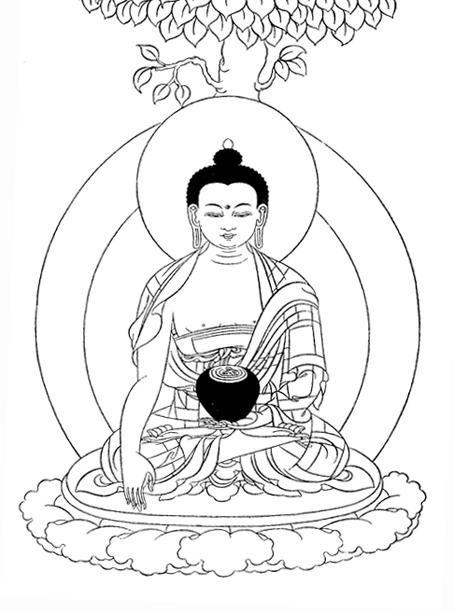
It is important to train ourselves to visualize this image and not to rely on a printed picture during our actual meditation session. Between sessions, however, we may acquaint ourselves further with the details by referring to the accompanying illustration.
For accepting safe direction and reaffirming our bodhichitta aim, we repeat three times each the following two verses. We should keep in mind that our root guru in this enlightening form incorporates and symbolizes the Three Rare Supreme Gems and does not constitute a fourth object to whom we turn for direction in life. Rather, he or she is the focus of access to the Three Gems.
I take safe direction from the gurus. I take safe direction from the Buddhas. I take safe direction from the Dharma. I take safe direction from the Sangha.
I take safe direction, till my purified state, from the Buddhas, the Dharma, and the Highest Assembly. By the positive force of my giving and so on, may I actualize Buddhahood to help those who wander.
We dissolve our visualization by imagining the entire image becoming smaller and smaller, then entering us between our eyebrows and disappearing like a drop into melted butter.
The Fourth Practice: Visualizing the Bountiful Field for Spiritual Growth
Traditionally, visualizing the bountiful field for spiritual growth (tshogs-zhing, field of merit) also entails an extremely complicated visualization of numerous figures. It too may be simplified to a mental picture of our root guru appearing, as above, in the form of a Buddha seated upon a splendid throne and wearing the three robes of a fully ordained monk. His right hand in the earth-touching gesture calls upon the earth to bear witness that he has overcome the demonic forces of the offspring of the divine, such as the devious Mara who had tried unsuccessfully to disturb his absorption. His left hand in his lap, in the mudra of total absorption (mnyam-bzhag phyag-rgya, Skt. samāhita-mudrā, mudra of meditative equipoise), holds a begging bowl filled with three “demon-defying” nectars (bdud-rtsi, Skt. amṛta). These are the nectar of medicine to eliminate sickness, the nectar of long life to challenge death and the nectar of deep awareness to eliminate taints (zag-pa, Skt. āsrava, contamination). They indicate his defeat, in turn, of the other three of the four demonic forces (bdud, Skt. māra), those of the aggregate factors of experience, of the Lord of Death and of disturbing emotions and attitudes.
Demonic forces may be either external or internal. The former includes, for instance, Mara himself, the one who had tried unsuccessfully to interrupt Buddha Shakyamuni during his absorption under the bodhi tree when he was demonstrating his enlightenment. Since such a limited being (sems-can, Skt. sattva, sentient being) is included among the divine beings of the sixth or highest divine realm on the plane of sensory desires, this type of interference is also known as the demonic forces that are the offspring of the divine.
Internal demonic forces, on the other hand, refer to the three poisonous attitudes of attachment, hostility and naivety and are also known as the demonic forces that are disturbing emotions and attitudes. There are two other demonic forces, making a total of four. These are the demonic forces of death (the Lord of Death) and those that are the aggregate factors of our experience.
We should feel that our spiritual mentor, the Buddha, is smiling and pleased with us. Drubkhang Geleg Gyatso has explained that because we normally do not follow the advice of the Buddhas, we would expect that they would not be happy with us. Now, however, we imagine that their joy at our doing this spiritual practice is like that of a mother seeing her naughty child finally doing something constructive.
Visualizing our spiritual teacher in this manner before us throughout the following practices is a skillful method for keeping us mindful of his presence. Embodying all objects that indicate a safe direction, he or she provides a bountiful field for our spiritual growth. We use this field to build up positive karmic force, to purify ourselves of negativities and make requests (gsol-’debs, Skt. adhyeṣaṇā). Unlike ordinary fields producing a small yield only once or twice a year, this one is so fertile it gives a bountiful harvest over and again. With ordinary fields, nothing will grow without a lot of hard work, whereas this is so fertile that merely dropping a seed (sa-bon, Skt. bīja, karmic legacy) of spiritual practice brings an abundant crop. Therefore, when such a field is readily available, it is foolish not to sow seeds in it.