The Fifth Practice: Offering a Seven-Limb Prayer and a Mandala, Which May Include All Essential Points for Collecting and Cleansing
To achieve the highest purified state, namely enlightenment, we must gather the causes and plant the seeds for both its physical and mental aspects, for both a Rupakaya (gzugs-sku, Corpus of Forms) and a Deep Awareness Dharmakaya (ye-shes chos-sku, Skt. jñāna-dharmakāya, Corpus of Deep Awareness Encompassing Everything). The causes for these can be categorized as either a union of skillful methods and discriminating awareness or a union of the two enlightenment-building networks (tshogs-gnyis, two collections):
- A network of positive force (bsod-nams-kyi tshogs, Skt. puṇya-sambhāra)
- A network of deep awareness (ye-shes-kyi tshogs, Skt. jñāna-sambhāra, collection of wisdom).
The most skillful method is developing the bodhichitta aim and then engaging in bodhisattva behavior motivated by such an aim. This builds up a network of positive force.
Discriminating awareness is the subsidiary awareness (sems-byung, Skt. caitta, mental factor) with which we realize voidness. By accustoming ourselves to such discrimination, we build up a network of deep awareness of reality.
Skillful methods and the network of positive force are the obtaining causes (nyer-len-gyi rgyu, Skt. upādāna-hetu) for achieving a Rupakaya, while discriminating awareness and the network of deep awareness serve as its simultaneously acting causes (lhan-cig byed-pa’i rgyu, Skt. saha-kāri-hetu). For achieving a Deep Awareness Dharmakaya, the obtaining and simultaneously acting causes are just the reverse.
Thus, we need method and wisdom as a joined pair (thabs-shes zung-’brel) and the two enlightenment-building networks for achieving each aspect, physical and mental, of the state of a Buddha. Neither aspect can be achieved on its own without the other.
Collecting and cleansing (bsags-sbyang), another term for preparatory practices (sngon-’gro, “ngondro”), is an essential part of the process for actualizing this highest goal. The purpose of a preparatory practice is to help build up our positive force and purify ourselves of all negative ones. More specifically, we work on building up the two enlightenment-building networks of positive force and deep awareness and purifying ourselves of obstacles to this process that might arise from our negative karmic forces.
Such practice is not limited to merely the initial stage of our spiritual training. We should never think, for instance, if we do 100,000 prostrations, that this will suffice for our entire journey. We must continue to build up positive force and purify ourselves of negativities all the way to achieving the essence of enlightenment with Buddhahood.
All essential points for collecting and cleansing can be included within the seven-limb prayer (yan-lag bdun-pa). The seven “limbs” are:
- Paying homage (offering prostration)
- Presenting offerings
- Openly admitting to our wrongs
- Rejoicing in constructive actions
- Requesting the endless flow of rounds of Dharma transmission (requesting the turning of the wheel of Dharma)
- Beseeching the teachers not to pass away into parinirvana
- Dedicating our positive karmic force.
Paying homage, offering, rejoicing taken in one sense, as well as requesting and beseeching build up a network of positive force; openly admitting purifies negativities; while rejoicing, taken in another sense, together with dedicating, causes the roots of positive force for the fulfillment of our spiritual aims to increase ever further.
There are numerous versions of prayers constituting a seven-limb prayer. At this point in the preparatory phase of our meditation session, we recite one while visualizing clearly before us the bountiful field of our spiritual mentor in an enlightening form representing all the Buddhas, the Dharma and the Sangha. Such practice plants in this field seeds that will ripen into the realization of our fullest potential, purifies any obstacles to this achievement and strengthens the roots that will grow from these seeds.
The following seven-limb prayer is from Shantideva, Engaging in Bodhisattva Behavior (sPyod-’jug, Skt. Bodhicaryāvatāra), II.24, 22, 28–29, III.3–6. Other well-known examples of verses for seven-limb prayers are Nagarjuna, A Precious Garland (Rin-chen ’phreng-ba, Skt. Ratnāvalī), IV.66–69, and the First Panchen Lama, Lama Chopa, 18–42.
(1) I prostrate to all you Buddhas who have graced the three times, to the Dharma and to the Highest Assembly, bowing down with bodies as numerous as all the atoms of the world.
(2) Just as Manjushri and others have made offerings to you, the Triumphant, so do I, too, make offerings to you, my Thusly Gone Guardians, and to your spiritual offspring.
(3) Throughout my beginningless samsaric existence, in this and other lives, I’ve unwittingly committed negative acts or caused others to commit (them), and further, oppressed by the confusion of naivety, I’ve rejoiced (in them) – whatever I’ve done, I see them as mistakes and openly admit (them) to you, my Guardians, from the depths of my heart.
(4) With pleasure, I rejoice in the ocean of positive force from your having developed bodhichitta aims to bring every limited being joy and in your deeds that have aided limited beings.
(5) With palms pressed together, I beseech you Buddhas of all directions: please shine Dharma’s lamp for limited beings suffering and groping in darkness.
(6) With palms pressed together, I beseech you Triumphant who would pass beyond sorrow: I beg you, remain for countless eons so as not to leave in their blindness these wandering beings.
(7) By whatever positive force I’ve built up through all of these that I’ve done like that, may I remove every suffering of all limited beings.
The three times are:
- What is no longer happening (’das-pa, Skt. atīta, the past)
- What is presently happening (da-lta-ba, Skt. sāmprata, the present)
- What is not yet happening (ma-’ongs-ba, Skt. anāgata, the future).
Paying Homage and Presenting Offerings
As for the first two parts, we have already discussed how to pay homage such as by making prostrations and how to present offerings such as the seven water bowls.
When reciting the appropriate verses in the above prayer, we visualize ourselves multiplying infinitely and all of us prostrating in unison. Likewise, when presenting offerings, we do so in the manner of the bodhisattva Samantabhadra by visualizing a cloud-like formation generated by one offering emanating many others, each of which in turn emanates still others and so on.
Openly Admitting to Our Wrongs
The third part, openly admitting to our wrongs, entails looking at ourselves honestly to see what mistakes we have made and then invoking four opponent forces (gnyen-po stobs-bzhi). These four together act as an antidote to purify us completely from having to experience the effects of the negative karmic forces built up from the wrongs we have done. We can only, however, eliminate such potential if it has not yet ripened into a problem. If we are already experiencing a suffering result, such as being blind, we cannot cure ourselves of it in this way. However, if we have built up a potential to be blinded, we can prevent such an event from ever happening by taking these measures. It is like burning a seed planted in a field. Even though it has definitely been placed in the soil, it will never grow or ripen.
Thus, Pabongka has said in Liberation in the Palm of Your Hand (rNam-grol lag-bcangs, 111.a3):
In general, although negative karmic forces have no good qualities, they do have one asset: once we openly admit to their presence, we can purify ourselves of them.
[1] The first opponent force is that of feeling sincere regret (rnam-pa bsun-’byin-pa’i stobs) about our previously committed destructive actions. This should not be confused with the inappropriate feeling of guilt. Rather, we regret having acted negatively in the same way we would regret having eaten contaminated food. We simply wish to avoid the suffering result.
[2] Second is the force of what we must rely upon (rten-gyi stobs). Acting negatively, we show disrespect to the Three Rare Supreme Gems and disregard our bodhichitta aim. Thus, the Buddhas and all limited beings are the actual objects against whom all our negativities have been directed and upon whom we must therefore rely to prevent experiencing problematic effects. By thinking of the Three Gems and turning to them for renewed direction and by reaffirming our bodhichitta aim, we activate the opponent force of relying on Buddha, Dharma, Sangha and the bodhichitta aim.
When we have eaten poisoned food, the pain in our stomach is not a punishment inflicted upon us by our doctor. It is simply the result of our own careless eating habits and our unawareness that the food was contaminated. In order to stop our pain from continuing and prevent ourselves from dying of the poison, we must call our doctor and rely on medicine, nurses and our wish for good health. In similar fashion, we must turn to the safe direction offered by the Three Rare Supreme Gems and reaffirm our bodhichitta aim in order to prevent further suffering resulting from our own disturbed and careless actions committed because of our unawareness.
[3] The third opponent force is our promise to avert repeating our mistake (nyes-pa-las slar-ldog-pa’i stobs). Just as we would vow never again to eat food that had once made us sick, so too we promise never to commit again whatever destructive actions, words or thoughts had caused us our troubles.
Dagpo Jampel Lhundrub has given a very useful guideline in connection with this point. When we promise not to commit again a certain negativity, if we were to say, “never again,” it might be a lie. Therefore, it is better to promise not to repeat the action for a day, a week, a month and so on – and at the end of the promised period to add further extensions. In this way, we can gradually forsake the specific destructive action altogether. This comes about by breaking the stream of its continuity and thus weakening the compelling strength of the murky karmic impulses (nag-po’i las, Skt. kṛṣṇakarmā, black karma) that arise out of habit.
[4] The fourth opponent is the force of remedial behavior (gnyen-po kun-spyod-kyi stobs) to counter and override our negative karmic force. This can include making offerings of prayers, honoring ceremonies, mandala offerings, meditation to build up beneficial habits of the mind such as discriminating awareness and so forth. We must dedicate the positive force built up by such rehabilitating, constructive actions toward everyone’s liberation from their suffering. Thus, our motivation for engaging in remedial behavior must not stem from selfish concern, but purely from our bodhichitta aim. When done in this way, happy effects will follow automatically by the laws of behavioral cause and effect.
For purging the effect of having eaten contaminated food, we must follow the treatment and take the medicine that our doctor has prescribed not as a punishment, but to help us. Similarly, we must perform, as an antidote, healing actions for our own welfare. Moreover, if both we and our only child were ill, we would follow our doctor’s orders more strictly and fervently than if we were concerned merely about ourselves alone. This is because we would be motivated by the intense wish to regain our health as quickly as possible so that we could care for our sick child. Likewise, we should engage in remedial behavior with the bodhichitta aim to attain enlightenment so that we will be able to serve and help all who suffer.
If we openly admit to our wrongs and invoke the four opponents with strong force, we can eliminate from their root the negative karmic forces they have built up. If we do so with only medium force, we can make these potentials lighter, and even with a minimum force, we can stop the potential from growing ever stronger. However, when we do not admit to or counter our negative karmic forces, they double in strength each day that they fester within. Thus, if we have swatted one fly today, tomorrow it will be the same as if we had swatted two, the next day four, and so on. We can understand this by considering how, if we have said something cruel to someone close to us, and their feelings are hurt, the longer we leave it without apologizing, the worse it becomes.
If we never face up or honestly admit to the wrongs we have done, this clearly shows we have no belief in the laws of behavioral cause and effect. However, if we are confident that whatever we do will bear its fruit, then we will act like Atisha. Whenever he traveled, if ever he did, said or thought anything even slightly negative, he would stop the entire caravan, take out his small stupa and openly admit before it to what he had just done.
Rejoicing in Constructive Actions
The fourth of the basic practices, rejoicing in constructive actions, is a very powerful and easy method for building up a vast network of positive karmic force. Tsongkhapa has said in The Progression of My Spiritual Life (rTogs-brjod mdun-legs-ma), 1:
For building up a network of great waves (of positive force) with a minimum of effort, rejoicing in constructive actions has been recommended as the best. Especially if, without being vain, we take an ever-growing joy at the positive things we ourselves have done in the past, the Triumphant One has said that (the strength of) these former actions will likewise increase.
Therefore, we rejoice both in our own past positive deeds that have brought about our present good circumstances and also in those we are presently doing that will bring about conducive situations in the future. Likewise, we call to mind and feel happy about all constructive actions of others: our friends, strangers and even our enemies. Also, by reading the enlightening biographies of past and present hallowed beings, we will have further opportunities to rejoice at positive deeds.
In Pabongka’s Liberation in the Palm of Your Hand and Tsongkhapa’s Grand Presentation, it is stated that we should rejoice in the glowing karma (las dkar-po, Skt. śuklakarma, white karma) of five kinds of persons:
- Ordinary beings who have not yet developed any of the five pathway minds (lam-lnga, Skt. pañcamārga, five paths)
- Shravakas
- Pratyekabuddhas
- Bodhisattvas
- Buddhas.
Everyone can be included among these five kinds of persons.
Once, King Prasenajit very proudly held a lavish banquet for the Buddha and his Sangha of shravakas, and one poor man at the back of the hall rejoiced in this display of generosity. Later, when Ananda asked the Buddha, who had built up the most positive force at the feast, the reply was that humble person in the rear who rejoiced at the king’s act.
Requesting the Endless Flow of Rounds of Dharma Transmission
When we request the endless flow of rounds of transmission of the Dharma, we visualize offering to our blissfully transformed master a thousand-spoked golden wheel. In this way, we imitate the action of the great divine Brahma, when he requested the Buddha to teach, for the Triumphant One had kept strict silence for forty-nine days after demonstrating complete enlightenment. Also, a spiritual master may not teach unless specifically requested. Therefore, it is important to make such requests.
Beseeching the Teachers Not to Pass Away into Parinirvana
Likewise, when we beseech the teachers not to pass away into parinirvana, we visualize offering a jeweled throne to our spiritual mentor, which then dissolves into the one upon which he is seated. We must always pray for the long life of the masters. They are the source of not only our own benefit, but also the welfare of all beings.
Dedicating Our Positive Karmic Force
We have already discussed how to dedicate the positive force built up from our acts. It is extremely crucial to do this immediately following any constructive action we do, to avoid seriously impairing the potential by becoming angry. Especially if the object of our anger is a bodhisattva, the consequences will be very dire indeed. And if we lack the advanced awareness to know others’ minds, we can never tell who is a bodhisattva.
As Shantideva has said in Engaging in Bodhisattva Behavior (VI.1):
Whatever generosity, offerings to the Blissfully Gone (Buddhas) and the like, and positive deeds I’ve amassed over thousands of eons – one (moment of) hatred will devastate them all.
Chandrakirti (6th century) has likewise said in Engaging in Madhyamaka (dBu-ma-la ’jug-pa, Skt. Madhyamākavatāra), III.6:
Because anger at spiritual children of the Triumphant can devastate in a moment the positive karmic force built up over hundreds of eons from generous giving and keeping pure ethics, there is nothing more destructive than impatience.
When Shantideva says that anger directed at a bodhisattva devastates the positive karmic force built up over thousands of eons, he is referring to when it is directed at a bodhisattva of a higher level mind than us. When Chandrakirti says it devastates that built up over hundreds of eons, he is referring to a situation in which we, as a bodhisattva, become angry with another such being with a same level mind as our own. When a positive karmic force becomes devastated, its ability to ripen into happiness is seriously impaired so that its results become much weaker and take considerably longer to appear.
If, however, we have properly dedicated the positive force of our constructive acts by praying, for instance, that it ripens in everyone’s attainment of enlightenment for the benefit of all, then even should we become angry, this will not affect that potential. This is because we have joined the power of what we have done with that of all the positive deeds of every bodhisattva who has ever striven for this highest goal. Thus, our own small merit will not exhaust so long as all these constructive forces endure.
Once, there were two men who set out on a caravan journey through the mountains. They decided to share their provisions. One had a tiny bag of yellow pea flour, while the other had a huge sack of white barley meal. They mixed the two together, and after some days the more affluent traveler said, “Let’s check our supplies. What you have contributed must surely have been used up by now.” When he looked, however, he saw yellow grains speckled throughout the white. He would have to share the flour until all was finished.
Thus, in the Sutra Requested by Sagaramati (Blo-gros rgya-mtshos zhus-pa’i mdo, Skt. Sāgaramatiparipṛcchā Sūtra), the Buddha has said:
Just as a few drops fallen in the great ocean will not dry up until the whole sea has disappeared, likewise any positive force dedicated properly to a purified state will not dry up until that state is attained.
His Holiness the Fourteenth Dalai Lama has further explained that if we dedicate our positive karmic force to ripen into a limited goal, such as happiness in this life, a future one or even our liberation from all suffering, that karmic force will cease to bear fruit once its aim has been fulfilled. Even if it is dedicated simply for our own enlightenment as one individual, it too will be depleted when that has been reached. If, however, we direct this positive force to ripen into the achievement of Buddhahood for ourselves as well as all wandering beings throughout the bounds of space, it will take the longest time for it to become exhausted. Therefore, we should make our dedications as vast and far-reaching as possible.
The seven-limb prayer is a very effective opponent for our disturbing emotions and attitudes. Paying homage, especially through prostration, counters our pride and conceit, making offerings counters our miserliness, while openly admitting to our wrongs is potent against all such poisonous attitudes as attachment, hostility and naivety. Rejoicing in constructive actions counters our jealousy, requesting Dharma teachings opposes any tendency to abandon or discard them. Beseeching the teachers not to pass away stops us from abusing or despising spiritual masters, while dedicating our positive karmic force prevents it from becoming devastated by our anger. Thus, this seven-limb prayer is indeed very basic, and we should never belittle or feel we can do without it.
Mandala Offering
Also fundamental is offering a mandala. The meaning of the Sanskrit term mandala is something that allows us to take the essence of what it represents. Here, such a symbol is of our world-system (’jig-rten, Skt. loka, universe), and by offering it to the Rare Gems, as incorporated and represented by our spiritual mentor, we are giving them everything. Such an offering is very powerful, not only for purifying ourselves of negativities and building up positive force, but also for habituating ourselves with the attitude of generosity necessary for practicing bodhichitta. This is the essence we must take from this round symbol.
Our world-system can be seen in many different ways depending upon the purity of the mind that experiences it. The Buddha has outlined two such ways – one in his teachings on abhidharma and another in the Kalachakra teachings. There are, of course, many other visions of a world-system, including the modern scientific one. However, as we have seen in the previous discussion of the Buddha Dharma, there is nothing incompatible in presenting many varying systems, each intended for a specific purpose and a different stage in our spiritual training. Drongtse Yongdzin (’Brong-rtse Yongs-’dzin Blo-bzang tshul-khrims) (1745–1800) addresses this point in his text The Path of the Two Stages of Glorious Kalachakra: Steps Leading to Unity (dPal dus-kyi ’khor-lo’i rim-gnyis-kyi lam zung-mjug bgrod-pa’i them-skas-pa), 2.b4–3.b2. He was a master of the Gelug tradition and a disciple of the Second Jamyang Zhepa (’Jam-dbyangs bzhad-pa dKon-mchog ’jigs-med dbang-po) (1728–1791).
- The First Jamyang Zhepa, Ngawang Tsondru (Kun-mkhyen ’Jam-dbyangs bzhad-pa Ngag-dbang brtson-’grus) (1648–1721), was the author of the set of textbooks (yig-cha) used by Drepung Gomang (’Bras-spungs sGo-mang Grva-tshang) and Drepung Deyang Colleges (’Bras-spungs bDe-dyangs Grva-tshang). Labrang Monastery (Bla-brang dGon-pa) in far-eastern Amdo, founded by Jamyang Zhepa, and most monasteries in Inner and Outer Mongolia, Buryatia, Kalmykia and Tuva also follow them.
At this point in our preparatory practice, then, we offer a mandala, traditionally conceived in the way it is described in abhidharma with four island-continents, one in each cardinal direction, each surrounded by two subcontinents, and with Mount Meru in the center. This offering can be made either with the appropriate hand-mudra (phyag-rgya) as in Figure 3 or, as in Figure 2, with a mandala set. This consists of a base, three rings and a jeweled top. It is constructed in a specific manner with jewels, coins or grain, placed within rings on top of a base.
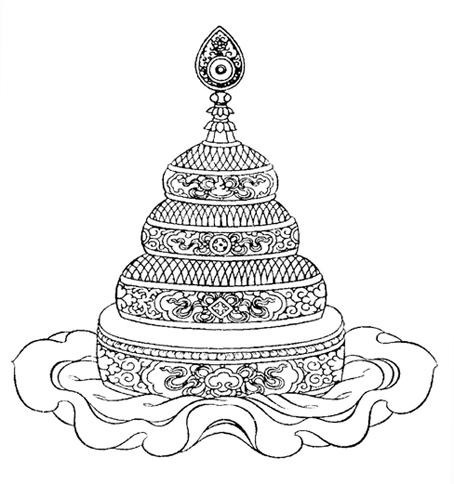
When making this symbolic offering, we visualize that we are presenting the entire world-system in our hands. Yeshe Gyeltsen wondered in his youth how an entire world-system could possibly fit on the small base of his mandala set. However, one day when he was served some tea at an offering ritual (mchod-pa, Skt. pūjā), he looked down in his cup and beheld his entire face reflected on its small surface. It then dawned on him that this was the way a world-system could likewise be seen reflected in the round base of the mandala set. A similar example is our ability to see an enormous mountain through the eye of a needle.
It does not matter how simple or humble our mandala set might be. It is not necessary that it be of gold or precious gems. It is how we view it and our motivating aim that count. When Tsongkhapa, at the age of thirty-six, did an intensive retreat on preparatory practices with eight disciples at Olkha Cholung (’Ol-kha chos-lung), he offered a mandala 1,800,000 times by using simply a flat piece of rock and sand.
Likewise, the Dharma King Ashoka (Chos-rgyal Mya-ngan med) (304–232 BCE), in a previous life, was a small boy who offered a handful of sand to Buddha Vipashyin (rNam-par gzigs). He placed it in the Buddha’s begging bowl and imagined his offering to be gold. As a result, he was later reborn as this incomparable king with the power to have erected ten million stupas in a single day. Vipashyin is one of the seven viras (dpa’-bo bdun-pa, Skt. saptavīra), the Buddhas before whom we can build up the positive karmic force for achieving the thirty-two excellent physical signs (mtshan-bzang, major marks) of a great person.
Also, in the Sutra of the Wise and the Foolish (mDdo mdzangs-blun, Skt. Damamūko-nāma Sūtra), XXVIII, a similar account is related, but with the boy offering the sand to Buddha Shakyamuni and receiving the power to have erected 84,000 stupas.
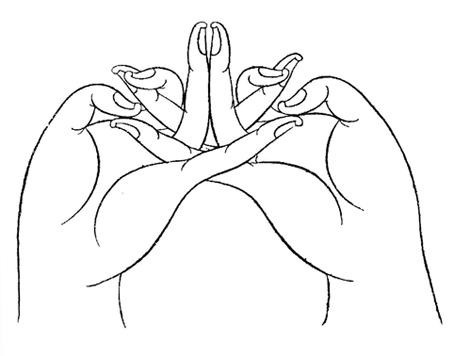
Here, for simplified practice, we may follow the method of offering a mandala with a hand-mudra, but visualizing it as an entire world-system. We make this mudra by raising our two ring fingers so that they touch back-to-back, forming a core mountain. We cross our little fingers before the ring fingers, with the right little finger closest to this mountain, and rest the thumbs of the opposite hands on the tips of the crossed little fingers. Behind this “mountain,” we cross our middle fingers, with the left closest to “Mount Meru” and grasp them with the index fingers of our opposite hand. In this way our fingers symbolize a core mountain surrounded by four island-worlds.
Then, we repeat the following verse of offering and prayer, after which we release our mudra.
By directing and offering to the Buddha-fields this base, anointed with fragrant waters, strewn with flowers, and decked with Mount Meru, four islands, a sun, and a moon, may all those who wander be led to pure lands.
Om idam guru ratna mandala-kam nir-yatayami.
I send forth this mandala to you precious gurus.
The Seventh Practice: Infusing Our Mental Continuums with the Inspiration of the Lineage Masters According to a Guideline for Making Requests
Inspiration (byin-gyis rlabs, Skt. adhiṣṭhāna, blessing) is something that helps our minds turn more easily to constructive tasks. To receive inspiration, we must request it, and the best source is the bountiful field of our spiritual mentor. As Dromtonpa has said:
Making requests to (my root teacher) Atisha has brought me more inspiration than making requests to anyone else.
There are many occasions when we need inspiration. Tsongkhapa has said:
If, when you listen (to the teachings), you cannot retain the words, when you ponder about them you cannot understand their meaning, and when you try meditate on them they do not take hold and grow on your mental continuum – at such times, when the strength of your mind is very weak, it is a guideline instruction to rely on the strength of the bountiful field.
Our mental continuum is the stream of continuity of our principal awarenesses (gtso-sems) – a consciousness and its accompanying mental factors. Whatever is taken as an object of such an awareness is considered as having been infused into or included on our mental continuums. Therefore, in order to feel we are definitely infusing our mental continuums (rgyud-dang ’dres-pa) with inspiration, we follow a guideline instruction for visualizing this happening in a graphic form.
For a simplified practice, we may do as follows. Holding the visualization of our root guru in enlightening form clearly before us, we request that he come and inspire us to achieve actual attainments.
O my glorious and precious root guru, come take your lotus and moon seat placed here upon my head. Take care of me always through your bountiful kindness and bestow on me please the actual attainments of your enlightening body, speech, and mind.
There are two types of actual attainments.
- The common actual attainments (thun-mong-gi dngos-grub, Skt. sāmānyasiddhi) or mundane actual attainments (’jig-rten-pa’i dngos-grub, Skt. laukikasiddhi) refer to the extraphysical and extrasensory powers of emanation (rdzu-’phrul, Skt. ṛddhi) and the clairvoyant powers of advanced awareness (mngon-shes, Skt. abhijñā) found in common among all yogis, including non-Buddhist. They are byproducts of advanced states of mental stability. These powers must be bypassed to achieve the higher goals.
- The uncommon actual attainment (thun-mong ma-yin-pa’i dngos-grub, Skt. asādhāraṇasiddhi), or supreme actual attainment (mchog-gi dngos-grub, Skt. paramasiddhi), also called the supramundane actual attainment (’jig-rten-las ’das-pa’i dngos-grub, Skt. lokottarasiddhi), refers to the state of Buddhahood.
We visualize that our guru happily accepts and then emanates a replica of himself that comes to the top of our head. There, on a flat, full moon-disc in the center of a pink lotus, he sits facing his counterpart before us. He then requests this Buddha to bestow on us, his disciples, waves of inspiring strength (byin-gyis rlabs, Skt. adhiṣṭhāna, blessings). The master in front accepts and radiates inspiration in the form of rays of light. These enter our hearts and, filling our bodies, eliminate the darkness of unreceptive attitudes. He then dissolves into his replica on the top of our head and to this remaining figure we offer the following abbreviated seven-limb prayer as well as a mandala.
The above verse of request, as well as the following seven-limb prayer and offering of a mandala are from Dagpo Jampel Lhundrub, A Ritual Text of Preparatory Practices (Byang-chub lam-gyi-rim-pa’i dmar-khrid myur-lam-gyi sngon-’gro’i ngag-’don-gyi rim-pa khyer bde-bklag chog bskal-bzang mgrin-rgyan, sByor-chos), 18.a5–19.a1. The first verse of the seven-limb prayer is from Tsongkhapa’s Abbreviated Points of the Graded Path (Lam-rim bsdus-don), 1.
(Bowing my) head, I prostrate to you, Foremost One from the Shakya (Clan): your body is born with a host of splendid, constructive, and excellent (signs); your speech grants the wishes of limitless wandering beings; your mind sees all knowables just as they are.
I prostrate before you, O (my root guru) complete amalgam of every source of safe direction. Like the precious Buddhas, you are my peerless teacher; like the precious Dharma, my peerless protector; like the precious Sangha, you are my peerless guide.
I present you all offerings, both these set before me and those sent from my mind. I openly admit to every negative karmic force and breach of vowed conduct that I have built up without a beginning. I rejoice at the constructive actions of both ordinary and high, realized beings. (I beseech you) to remain until all of samsara has ceased; set flow rounds of Dharma transmission for all of us who wander. I dedicate my own and others’ positive deeds toward the enlightenment (of all limited beings).
This bountiful array of totally excellent Samantabhadra offerings and this precious mandala, symbol of a world-system with four island-worlds, Mount Meru, a sun and a moon, and the seven precious symbols of royalty I offer to you, O my teacher, my personal yidam, my Three Rare and Supreme Gems. Accepting these out of your compassion, send forth to me waves of inspiring strength.
The seven precious symbols of royalty (rgyal-srid rin-chen sna-bdun) are a precious wheel, jewel, queen, minister, elephant, horse and general.
We follow this by seven, twenty-one or one hundred repetitions of the name mantra of Buddha Shakyamuni:
OM MUNI MUNI MAHA-MUNIYE SVAHA
We maintain on the crown of our head the image of our root guru in enlightening form throughout the actual fundamental part of our meditation session. This may be on the subject of relating to our mentor in a healthy manner or on any of the graded stages of the path, all of which are rooted in that deep commitment. In fact, we should maintain this visualization throughout the remainder of the day. By this guideline technique, our spiritual mentor will help restrain us from acting negatively and will also witness whatever constructive actions we do.
If these various visualization practices are difficult at the beginning, we should simply try our best and at least have firm conviction and a positive feeling that the imagined processes are occurring. As Kyabje Trijang Rinpoche has said, “Do not worry about how all the small details and figures fit into your mandala. Just offer it.”
Once, there was a man who took everything literally and tried to make his visualizations solid. He became so confused that instead of seeing his teacher on his head, he imagined it the other way around, that he was sitting on his teacher’s head. And then, because his master was bald, he became very upset because he kept sliding off!
So many people these days seem interested in meditation, but few understand what the word actually means. Tsongkhapa has defined it well in A Grand Presentation of the Graded Stages of the Path (41.a5):
Repeatedly directing your mind at a positive object and building up (the beneficial habit of taking this as) your focus and (regarding it in a certain constructive) way is what is known as meditation.
Pabongka has explained it further in Liberation in the Palm of Your Hand (122.a4–6):
Meditation means applying or affixing your mind to an object and is done as a method for familiarizing or habituating (your mind with that object). For instance, suppose you wish to rechannel and change your attitude from one of having no faith in your spiritual teacher into one of having such faith. Since (meditation) functions as a method for familiarizing (your mind with a new, constructive attitude), you would meditate in order to have your mind be under your control. In other words, (meditation) is done for the sake of reversing your mind’s having been under the control of disturbing emotions and re-applying it to a (positive) object.
In order to build up through meditation a new, more beneficial habit of the mind, we must first listen to or read a correct explanation of the measures involved. Otherwise, we will have no idea of what we are doing or where we wish to lead our minds. As a result of listening, we will get an accurate verbal idea (sgra-spyi, Skt. śabdasāmānya, audio category) of what we wish to cultivate. In order to gain an accurate idea of what the words actually mean (don-spyi, Skt. arthasāmānya, meaning category), we must ponder carefully the meaning of what we have heard. This will eliminate any interpolations (sgro-’dogs, Skt. āropa, fanciful ideas) we might project onto the practices and give us the self-confidence of knowing what we are doing.
We ponder or think about the teachings not only to understand what they mean, but also to check their validity. Without conviction in the propriety of what we are doing, we will be haunted by doubts and our chances for success will be slim. Therefore, the Buddha has said in the Sutra (on Pure Realms) Spread Out in a Dense Array (sTug-po bkod-pa’i mdo, Skt. Ghanavyūha Sūtra):
O monks and nuns, do not accept my teachings merely out of respect for me, but analyze and check them the way that a goldsmith analyzes gold by rubbing, cutting, and melting it.
In fact, the Buddha has outlined four reliances (rten-pa bzhi) with respect to the Dharma:
- Do not rely on a teacher’s fame or reputation, but only on what he or she has to say.
- Do not rely on the eloquence of his or her words, but only on their meaning.
- Do not rely on the explicit suggestive meanings, but only on the implicit suggested meaning.
- To fathom this, do not rely on an ordinary consciousness to which things appear differently from the actual way they exist, but only on one of deep awareness to which there is no such dualistic appearance.
Thus, once we have understood a teaching and the phenomena with which it deals and have a firm idea of both in our minds, we check that they make sense from the point of view of the four axioms (rigs-pa bzhi):
- With the axiom of dependency (ltos-pa’i rigs-pa), we consider the causes and conditions postulated for a phenomenon and whether or not they are appropriate and fitting. Or we consider, for instance, the deepest truth (don-dam bden-pa, Skt. paramārtha-satya, ultimate truth) about a phenomenon and does it make sense in terms of the superficial truth (kun-rdzob bden-pa, Skt. saṃvṛti-satya, conventional truth, relative truth).
- Next, we consider them according to the axiom of functionality (bya-ba byed-pa’i rigs-pa). For instance, fire and burning make sense as one being the function of the other.
- It should all accord with the axiom of establishment by reason (tshad-ma’i rigs-pa) as well. The teaching and the phenomena involved must not be contradicted by either valid bare cognition (mngon-sum tshad-ma, Skt. pratyakṣa-pramāṇa, valid straightforward cognition), valid inferential cognition (rjes-dpag tshad-ma, Skt. anumāna-pramāṇa) or scriptural authority (lung, Skt. āgama).
- Lastly, we see if they make sense in terms of the axiom of the nature of things (chos-nyid-kyi rigs-pa). For instance, fire’s burning upwards and water’s flowing downwards make sense simply because they are the nature of fire and water.
Tsongkhapa has said in A Prayer for Constructive (Actions) in the Beginning, Middle and End (Thog-ma-dang bar-dang tha-mar dge-ba’i smon-lam, Thog-mtha’-ma), 14:
Having examined fully and correctly with the four axioms, day and night, the meanings of (the teachings) that I have heard, may I cut off indecisive wavering with the analytical state of mind that’s arisen from having thought about the points to be thought about.
Once we have pondered in this way a teaching concerning some phenomenon and have both understood it and become convinced that it makes sense and is fitting for us to adopt, we must then follow the techniques for building it up as a habit of mind. Formally speaking, this is what we call meditation. There are three basic methods involved. We build up something as a habit of the mind by
- Repeated review (bshar-sgom, investigative meditation)
- Discerning meditation (dpyad-sgom, Skt. vicāra-bhāvanā, analytical meditation)
- Stabilizing meditation (’jog-sgom, Skt. sthāpya-bhāvanā, placement meditation).
[1] When we repeatedly review a body of material such as by daily going over an outline or a certain sequence of mental exercises, we gradually assimilate it.
[2] Once we have thoroughly pondered many lines of reasoning, examples, quotations and the four above-mentioned points for checking that something makes sense, we can discern things in light of our decisive awareness (nges-shes, ascertaining consciousness) of what we have understood. For instance, we can generate a new, constructive attitude (dge ba’i sems, virtuous mind) toward something and see it as making sense in terms of dependency, functionality, establishment by reason, the nature of things and so on. Repeatedly discerning something like this builds up a strong habit. Pondering, then, is an analytical process of figuring something out and is always conceptual (rtog-bcas, Skt. savikalpaka), whereas discerning meditation is to apply what we have finished pondering and see things in terms of our conviction in it. Therefore, it can be either conceptual or non-conceptual (rtog-med, Skt. nirvikalpaka) and can be generated either with or without direct reliance on a valid line of reasoning.
In Gelug Prasangika, a valid cognition is any non-fallacious (mi-bslu-ba) awareness of something. There are two kinds, inferential cognition and straightforward cognition. Unlike the presentation given in Sautrantika, a valid cognition need not be fresh (gsar-tu). Even its subsequent phases (bcad-shes) are valid. An inferential cognition relies directly on a valid line of reasoning and is always conceptual, while a straightforward cognition arises without such a reliance. Unlike bare cognition in Sautrantika, then, straightforward cognition need not be non-conceptual. It can be aware of either a correct idea of something or of the thing itself as the object appearing to it. So long as it perceives its appearing object (snang-yul) non-fallaciously and straightforwardly without directly relying on the force of a line of reasoning for its arising, it is a valid straightforward cognition. An example of a conceptual one would be later phases of awareness of an object that were initially generated by an inferential cognition and which now perceive that object straightforwardly through the medium of a meaning category of it. A non-conceptual one perceives an object without such a medium.
Furthermore, also unlike in Sautrantika, straightforward cognition can have either an explicit apprehension (dngos-su rtogs-pa) or an implicit apprehension (shugs-la rtogs-pa) of either a nonstatic or a static phenomenon. Only an object appearing to the cognition can be explicitly apprehended. A conceptual straightforward cognition would have an explicit apprehension of its appearing object, for instance a static meaning category of something, and an implicit one of the conceptualized object (zhen-yul, implied object), whether it be nonstatic or static. A non-conceptual straightforward cognition would have an explicit apprehension of either a nonstatic or a static phenomenon as its appearing object, and an implicit one that establishes the occurrence of the nonstatic phenomenon of this perception itself. It should be noted that, through this mechanism of implicit non-conceptual straightforward cognition, Gelug Prasangika does away with the necessity for asserting a way of being aware of something called “reflexive awareness” (rang-rig, Skt. svasaṃvedana) and its bare cognition as a means for validly establishing the occurrence of a cognition of anything [as cited by Tsongkhapa in Totally Clarifying the Intentions [of Chandrakirti’s Supplement to (Nagarjuna’s Root Verses on) Madhyamaka] (dGongs-pa rab-gsal) (Sarnath ed.), 296–299; and by Akya Yongdzin (A-kya Yongs-’dzin dByangs-can dga-ba’i blo-gros) (1740–1827) in A Compendium of Ways of Knowing: A Clear Mirror of What Should be Accepted and Rejected (Blo-rigs-kyi sdom-tshig blang-dor gsal-ba’i me-long), passim].
(3) Once we have actualized a stilled and settled state of mind, one in which we have both absorbed concentration and a strong sense of physical and mental fitness (lus-sems shin-sbyangs, Skt. kāya-citta-praśrabdhi, physical and mental pliancy), we can further build up beneficial habits of the mind. This we do by setting the mind, either conceptually or non-conceptually, on the new constructive attitude we wish to adopt and assimilate.
Normally, we do build up states of mind through repeated discernment. However, this occurs mostly when we work ourselves up into a poisonous frame of mind such as anger. For instance, we start out not thinking about someone who has previously wronged us. We are not upset, but then something reminds us of this person. We start to review all the nasty things he said or did to us. Mulling over these incidents and seeing him in this light, we work ourselves up to such a fit of rage that, if suddenly this person were to enter the room, we would bite his head off. We apply this same technique in our meditation session to work ourselves up to constructive states of mind such as a whole-hearted commitment to our spiritual teacher.
In summary, we conduct a meditation session as follows. We begin with the preparatory practices and prayers as outlined above, making sure to sweep our room and set up our water bowls and offerings ourselves. Even when Atisha was old and weak, he always filled his water bowls himself. He usually spilled quite a lot since his hand used to shake. His disciples offered to do it for him saying, “You must be very tired. Let us offer them for you.” However, Atisha sarcastically jibed back, “When it’s mealtime, are you also going to say, ‘You must be very tired. Let us eat your portion for you!’” Therefore, whenever we offer anything to someone, we give it with our own two hands and do not have anyone else do this for us. By attending personally and fastidiously to the preparations for our session, we ourselves build up a positive force and eliminate any negative one that could bring about hindrances that would prevent us from making progress.
During the actual fundamental part of our session, we work on building up the beneficial habit of taking preventive measures, so that we actually develop them as paths of mind. Therefore, beforehand, we need to have acquainted ourselves well with the subject matter involved by having either listened to a lesson or read a portion of such aids as this text. Next, we need to have pondered its meaning either during a separate session or in an informal manner so that we understand it fully. It is a guideline instruction that after each lesson or reading of a section, we place our closed notebook or text before us on our table and try to recall what we have learned. If we can synthesize and abbreviate the essential points, it is a sign we have begun to understand. However, if we cannot organize it coherently and are left with just a jumbled, unruly mass of material, this indicates clearly our lack of comprehension. If we cannot recall anything at all, we look once more at our notes or the text. However, if we start off always relying on reading the text, without any attempt to remember its contents, it will be difficult to make much progress in assimilating the material.
In order to be a great teacher, we need to know by heart the subject matter and scriptural references. Otherwise, when we teach, we will have to depend heavily on notes and books and will be unable to explain things fluently by ourselves. The same is true when, in meditation, we try to build up the preventive measures as habits of the mind. If we do not know the material off by heart, we will always have to look things up. Like a cripple and his crutch, we will always be dependent on our notebooks or texts, and it will be difficult ever to integrate anything into our minds. Therefore, during the day we try to memorize the root texts or the outlines, and at night recite them without consulting any books. However, we should not go to the extreme of memorizing too much without knowing the meaning. Otherwise, we become no better than a parrot. We must ponder carefully whatever we have learned so that we understand it fully.
The Gelug master Gungthang Rinpoche (Gung-thang Rin-po-che dKon-mchog bstan-pa’i sgron-me) (1762–1823) has summarized these points in A Guide for Pathways of Mind Leading to the Isle of Jewels (mDo-sngags-kyi gzhung-la slob-gnyen byed-tshul-gyi bslab-bya nor-bu’i gling-du bgrod-pa’i lam-yig), 14–15:
The old man of the meaning must lean on the cane of the words. So, if we never memorize the words of the classics, but only have as our daily practice merely reading the texts and talking a little about them, this will not be of help. Take time to memorize the texts and recite them by heart, you hear? However, even if we have memorized many words of the classics and can recite them by heart, to do so hundreds of times without having their meaning in mind is like a ritual reading aloud of the scriptures or a parrot’s reciting. It will never rid us of interpolations projected onto what we are saying. So, analyze carefully and discern the meaning, you hear?
Furthermore, no matter what we study, we rely on the root text, not its commentaries, for building up the material as a habit of mind. These texts, designed to function as a root for awareness to grow, have purposely been written in a vague, open style with a great many “this’s” and “that’s” so that we ourselves must fill in the meaning or reference. This acts as a powerful learning tool since it forces us to remember the meaning. Had the illustrious authors wished to spell out everything clearly and fully, they would surely have done so. As omniscient beings or aryas (’phags-pa, Skt. ārya, noble ones), they were certainly capable of so doing. Therefore, we must try to appreciate the reasons why they wrote as they did and not disparage the texts or their authors for being so difficult to understand.
Our wish that all the texts be more specific indicates how limited our intelligence is. When we narrow things down to a single significance, this does not allow for the breadth and scope of the many levels of meaning and interpretation that there are. The intentionally open style of a root text provides the ample space for a lush growth of multivalent understandings to sprout. Therefore, when reciting a root text, we aim to be aware of as many of these levels as we can and always allow ourselves room for further new insight.
When Buddha Shakyamuni was gracing the earth with his commonly visible presence, disciples were the most intelligent. The sutras were themselves sufficient for their needs. As time passed and the Buddha was no longer present in the form of a Supreme Nirmanakaya (mchog-gi sprul-sku, Supreme Emanation), more and more commentaries were required since people’s minds were far less agile. Therefore, Kyabje Trijang Rinpoche has said:
Those who understand a root text are wise. If we must always rely on a commentary for our comprehension, this is not a good sign.
Once we have memorized and understood a root text or, in this case specifically, such works as Tsongkhapa’s Abbreviated Points of the Graded Path or at least the outline of these graded stages, we begin the actual fundamental part of our session by reciting it, ever mindful of the meaning. Such a process of repeated review will help us build up the habits outlined within. It is not essential to do such a review at each of our sessions. Still, whenever we can do so, we will find it useful, especially for remaining aware of the entire course of the graded stages of the path.
We then choose a specific section from the outline of these paths as the main focus for our session. We must be sure, however, to select these topics in their proper sequential order. As we have seen above, this is one of the benefits: they have been especially designed in a graduated order that is easy for training our minds.
We should never skip ahead, feeling that we are so advanced we need not train in the earlier subjects. If we have not built up the attitudes of the prior steps as actual states of mind, how can we develop pathways of mind that will lead anywhere? Can we build the upper stories of a building while omitting any of the lower floors?
After reviewing the relevant points of the section of the outline, we work ourselves up to generating the desired attitude, such as feeling a wholehearted commitment to our spiritual mentor. This we do by going through the same type of material we had pondered before when trying to figure out the meaning of this measure and to become convinced of its validity and propriety. Now, however, we remind ourselves of the quotations, examples, lines of reasoning and so on and try to discern our spiritual teacher in light of them. This we do by looking at incidents and events from our own experience with him. Such an active process of discerning will make a strong impression on our minds and help us build up the beneficial habit of always feeling such commitment to him, not only in the controlled situation of our meditation session.
While building up this attitude through an active process of repeated discerning, we supplement this procedure by occasionally stabilizing each mental aspect (rnam-pa, Skt. ākāra) of the attitude as we come to experience and feel it. Whether or not we have actually attained through prior training a stilled and settled state of mind (zhi-gnas, Skt. śamatha, calm abiding), which we can apply in this situation, we try setting the mind on these aspects with whatever powers of concentration we possess. Doing so will help stabilize these attitudes and impress them deeply on our mental continuums.
In short, repeatedly alternating discerning and stabilizing, based on review, is the technique known as “meditation,” a procedure for taking the reins of our minds and replacing negative attitudes with constructive ones. At the end of such a meditation session, we dedicate the positive force built up. The specific method will be discussed below.
Before entering upon these practices, it is customary to invoke the aid of Manjushri to develop discriminating awareness and clarity more easily. Manjushri does not number among the 1,000 Buddhas of this particular eon who, as historical figures, will reintroduce the Buddhist teachings after dark ages. He attained perfect and total clear evolvement long ago, before Buddha Shakyamuni who is the fourth and current one of the 1,000 [as cited in the Fortunate Eon Sutra, bsKal-pa bzang-po’i mdo, Skt. Bhadrakalpika Sūtra].
- The first three Buddhas of this eon were Kakutsunda (’Khor-ba ’jig), Kanakamuni (gSer-thub) and Kashyapa (Sangs-rgyas ’Od-srung). The fifth will be Maitreya.
As Manjushri taught Buddha Shakyamuni, so too will he act as our teacher while we are striving to reach enlightenment. This is why he is called “the sole father of all the Triumphant Ones” (rgyal-ba kun-gyi yab-gcig). Once we have actualized our fullest potential, he will act as our spiritual son and embody the omniscient aspect of our Buddhahood.
We call upon Manjushri before meditation sessions, all formal lessons and also when pondering the teachings, by repeating the following prayer of request, Praise to the Intelligent One (Gang blo-ma, Manjushri Prayer):
I prostrate before my guru and guardian, the ennobling, impeccable Manjushri.
Your intelligence shines forth like the sun, free from the clouds of the two obscurations, enabling you to see the extent of all things and how they exist: thus, you hold a scriptural text to your heart. Your affection for all of us masses who wander, plagued with problems, groping in the darkness of ignorance in the dungeons of our compulsive existence is like that for your only child: thus, your speech is melodious with sixty facets. Its thunderous roar arouses us from the stupor of our disturbing emotions, frees us from the iron chains of our karma, dispels the gloom of our lack of awareness, and slashes our problems wherever they sprout: thus, you brandish a sword.
Pure from the core and having traversed the ten bhumis, your set of enlightening qualities is complete: thus, as a spiritual son of the Triumphant Ones, your body is bedecked with the enlightening adornments, ten times ten, plus twelve. Please remove the darkness from my mind. O Manjushri, I bow down to you.
OM-A-RA-PA-TSA-NA-DHIH [repeat many times]
DHIH-DHIH, DHIH-DHIH, DHIH-DHIH [repeat many times]
Affectionate one, with light-rays of your supreme omniscience clear the darkness of naivety from my mind. Direct me, please, so that confident intelligence emerges within to comprehend fully the classic texts of Buddha’s words and the treatises on them.
The two sets of obscurations are:
- Emotional obscurations (nyon-sgrib, Skt. kleśāvaraṇa) – obscurations that are disturbing emotions and attitudes, and which prevent liberation
- Cognitive obscurations (shes-sgrib, Skt. jñeyāvaraṇa) – obscurations regarding all knowables, and which prevent omniscience.
The Way of Presenting the Preparatory Steps in the Lam-rim Texts
The organization of the outlines of Pabongka’s Liberation in the Palm of Your Hand and Tsongkhapa’s Grand Presentation diverges in terms of the order in which the preparatory steps are expounded. Tsongkhapa first treats the topic of relating to a spiritual mentor in a healthy manner and then discusses the six preparatory practices in the context of the methods for meditating on this commitment in order to build it up as a habit of the mind. In Personal Instructions from Manjushri, the Fifth Dalai Lama argues for the necessity and propriety of mentioning how we should take safe direction and reaffirm our bodhichitta aim prior to cultivating our healthy relationship to a spiritual mentor, despite the fact that Tsongkhapa calls such commitment the root for developing all pathways of mind. Except for the brief discussion of this point, however, the Fifth Dalai Lama follows the above-mentioned order of Tsongkhapa’s outline. Pabongka, on the other hand, follows the order found in the Second Panchen Lama’s Speedy Path and presents the full preparatory practices before he explains how to cultivate a healthy relationship with our spiritual mentor.